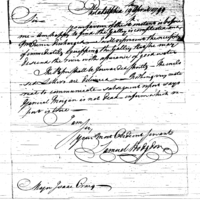
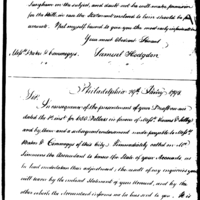
Samuel Hodgdon informs Major Craig that materials needed for the galley will be obtained and shipped rapidly. Hodgdon also mentions that paper supplies will be forwarded shortly.
The Secretary at War asks that future requistions made on behalf of equipping the gallies contain more detailed information to assist in accurate procurement.
Harris is asked to receive the muskets and bayonets which have arrived on the ship "Connecticut,'" under the command of Captain Hylander. Harris should obtain an order for them on the Captain from the Secretary of the Treasury and have them deposited in the public store.
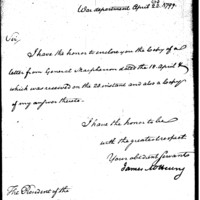
Forwards reports of 2 courts martial. First discusses the charges of Andrew Anderson, a soldier: that he deserted, freed prisoners at the fort, and lost his arms and accoutrements. Anderson was convicted of the first and third charges, and sentenced to hang. In the second, a Sergeant Tisdale was charged with desertion, convicted, and sentenced to be shot. McHenry advises Adams on how "well-placed examples have a beneficial effect on the military service."
Vance is clearly frustrated by the lack of instruction he has received regarding the number of officers, etc. which are permitted on the muster rolls. He feels that is he is to perform his duties as described by the act of Congress, he cannot account for the various men who request payment for their duties.
Miller has supposed that clothing was not to come through his department except when it is related to the transportation business. The enclosed invoice contains vests for private artillery men. He wants to know, therefore, if every article of every description that is requested of Mr. Harris by the Secretary of War is to come through the Quartermaster General's books.
Boyd assures Hamilton that he could arrange for the production of gun carraiges for the vessels under construction at a cheaper rate than is currently being paid.
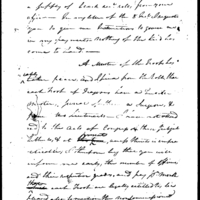
MacPherson describes the recent movements of his troops in suppressing the current insurrection in Pennsylvania, as they attempt to arrest individuals charged with treason. Discusses disposition of different detachments, arrests made, intelligence about the movements of the insurgents; supposes on the opinions of the people in the region, believing that the spirit of revolt was "high and general" before the arrival of federal troops. Believes the situation has stabilized enough that the militia can be sent home, but that the regular troops should garrison the region for the near future. Asks for instructions regarding the dispersion of the regulars into garrisons. A postscript concerns additional persons to be arrested and mail for the troops.
Acknowledges receipt of letter from James Miller, Deputy Quartermaster General. Reports payment of bill. Encloses check on the draft of the local branch bank in New York.