The Secretary of War has authorized the hiring of temporary drummers and fifers for the recruiting service until others can be enlisted. New recruits should not remain long at their company rendezvous but should immediately march to their District or Regimental rendezvous.
Wants to know about the marks and number of hogsheads used for conveyance of clothing from Albany to northern posts of Oswego and Niagara. Wants to know if each hogshead contained a list of its contents.
Addresses the issue of a Captain Gates, who was instructed to recruit but not to promise any officer positions to individuals. Gates apparently did so, promising a man an appointment as a cadet (referred to as a rank between that of sergeant and lieutenant). States that such practices must be stopped, and later proposes an added clause to recruiting instructions which clarifies the point. Informs Adams that a man he recommended is being appointed a cadet in the 2d Regiment of Artillerists and Engineers.
Hamilton questions whether he has the authority to approve or disapprove sentences of Court Martials that have been instituted by officials other than himself.
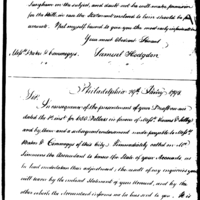
States that 500 muskets and 63,500 flints have been delivered from Hamburg to Ebenezer Stevens, the New York Agent of the War Department. Also mentions New York merchants James and Ebenezer Watson, whose accounts were adjusted for freight charges upon the importation of cannon and small arms.
Routine correspondence concerning the appointment, transfer, promotion, discharge, desertion, leave, and assignment of individual officers and soldiers.
Refers to previous accounts of muskets, cases, gunworms, and proving wires received from James & Ebenezer Watson. Expresses concern that one record does not match up the other; anxious to rectify accounts. Seeks advice on a reputable boarding house in York run by Mrs. Montgomery.
Reports delivery of Charlottesville muskets and cartouche boxes for volunteer corps. Arms and equipment is now with a company of militia in Bristol. They must follow the law for disbursement of arms.
Anxious to adjust and close accounts of Mr. Faesch. Must first determine if the shot provided is taken for the use of the states and where it is located. Requests direction on how to proceed. If Hodgdon is to attend to the business, he requires a few days' advance notice to alert Faesch.
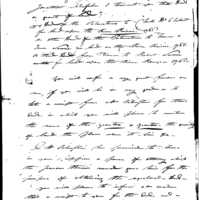
Certification of payments; $60 to Jonathan Rhea for compensation and expenses in making contracts of articles for the posts of Rendezvous in New Jersey, to include Hackensack, Elizabeth Town, Trenton, New Brunswick, Burlington, New Jersey.
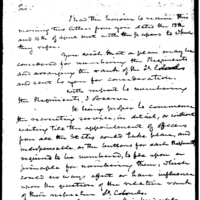
Refers to the appointment of officers and the numbering of regiments. Seeks careful governance. Plans to raise regiments in North and South Carolina and Kentucky, with plans in New Hampshire, Vermont, and Rhode Island.
Discusses need to number the new regiments, so that recruiting may begin and buttons may be issued, in a fashion that does not affect the relative rank of the officers now being appointed for those regiments. Dictates that the numbering of the regiments (and thus their lieutenant colonels) be geographical, starting with those recruited from the southernmost states. Discusses the overall system as it relates to the relative rank of the officers of the original four regiments as well.
Refers to Captain Charles Hyde as settling large sums of money, working with the regimental paymaster. Refers to an act to better organize the troops and plans for promotions. Mentions potential role as principal accountant of the War Department.