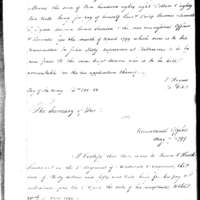
Cobb certifies that when he visited Fort Triggs the detachment commanded by Lt. Wilkins had not been at the post long enough to have been mustered; therefore he inspected but did not muster them.
Tracy provides a list of recommend officers to fill vacancies in the Provisional Army. Tracy also expresses frustration with the authors of the Virginia and Kentucky Resolutions, along with a concern that John Fries of Fries's Rebellion will be pardoned.
Certification of payment; $1403.56 to detachment of recruits stationed at Charlottesville, Virginia under command of Lieutenant Meriwether Lewis, 1st Regiment of Infantry, for pay.
Addresses the case of a Mr. Cotton, whose payment for services performed as an assistant clerk and as Schoolmaster was in question. After receiving accounts of his services from the president, McHenry authorizes Cotton to receive all benefits due to a clerk.
McHenry instructs Governor Sargent on how to account for expenses related to gifts and supplies to the neighboring Indians. Accordingly, all bills, receipts, and vouchers should be submitted to the Accountant of the War Department.
Examined account of J. Gaither for payments made by him to Georgia yielded information that stated Gaither paid McLean at same time of McLean's resignation. Therefore McLean is charged by Accountant's Office for money owed government.
Suggests that to have solicited men to offer themselves to fill offices in the Provisional Army, the United States would sent a message to Europe that a potential war with France was unpopular, forcing the government to pursue extraordinary means to fill positions. Suggests that such an invitation may have brought in officers with "adverse political principles." This is why, instead, McHenry has been pursuing recommendations from trusted individuals.