Routine correspondence concerning the appointment, transfer, promotion, discharge, desertion, leave, and assignment of individual officers and soldiers and routine instructions and correspondence concerning Army recruiting.
Routine correspondence concerning the appointment, transfer, promotion, discharge, desertion, leave, and assignment of individual officers and soldiers.
Hamilton encourages reinforcing the post at Detroit in lieu of strengthening the one at Michilimacnac. He discourages the exercise of martial law at Detroit which will anger the inhabitants and the civil authorities. Military leaders are not to interfer with Governor Sinclair as he exercises his authority as Superintendent of Indian Affairs.
"It has happened in one instance which has come to my knowledge that the hats sent on for the recruits has been destitute of cockades and loops. In a similar cse I authorize you to procure the deficiencies to be supplied and I will take care that the expense is defrayed. Where there is an agent of the War Department, you will first apply to him to have what is necessary done; but you will at all events have it done. I speak only as to hats."
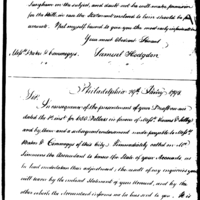
Request to deliver public clothing left in Windsor, VT, for the effort to raise 12 regiments. Leverett should take 2 receipts, one to return to Hodgdon and the other to the paymaster of the regiment, who will adjust the the regiment's pay accounts.
Inquires about whether Haragan has accounted with O'Hara for bills due. Needs to know which account to debit. Notes that the Treasury ordered to close O'Hara's debit, and all subsequent accounts should be credited to his successor. Asks about bill to quartermaster of Niagara.
Responds to inquiry for hoop and red iron. Refers to the return of stores and the musket stocks damaged by fire. Promises to send supply of musket stocks by the first convenient conveyance. If the horse purchased for the Superintendent is too vicious, it should be sold and another bought to replace it, or a yoke of oxen as an experiment.
Informs the Supervisor at New York that the Treasurer will remit him the sum of 174 dollars for pay, subsistence, and forage of George Davis, temporary surgeon's mate.
According to the accounts transmitted to Simmons by the Quartermaster General, Samuel Henley appears to have drawn pay and subsistence as an assistant Quartermaster for eleven months of the same period for which he was paid as Conductor of Military Stores. Since the pay is the same for both posts, it does not seem that he is entitled to additional compensation.