The Secretary at War asks Colonel John Eager Howard to provide him names of men from each county in Maryland that may be able to aid in the selection of army officers.
Jonathon Williams requests transaction of his recommendation relative to his father-in-law. Refers to Mr. Francis's resignation from the Navy with discussion with Mr. Stoddart about replacement with Mr. Harrison.
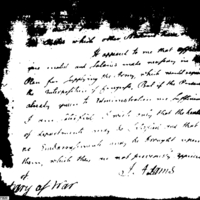
Stresses the need of clothing and other supplies for new recruits and asks why no issues have yet been ordered to Major General Hamilton to raise six additional companies of cavalry.
Stoddert declares that commanding officers of Navy ships must adhere to the health regulations of the cities where they are docked. He worries that Captain Talbot will not go out in the "Constitution" and, even if he does, Captain Truxton will quite the service in fit of pique. This is typical of the ill effects of the avarice of rank even though it would be an effective means of training younger officers.
Senator Dayton requests some additional information about the supplying of rations to U.S. troops stationed in both Elizabethtown and New Jersey as a whole. Dayton wishes to know whether the supply of rations such as beef and pork will be delivered to any one post in particular, or to the whole state of New Jersey. Dayton also wishes to know whether the rations will be divided proportionately, or left to the contractor or commanding officer to decide.
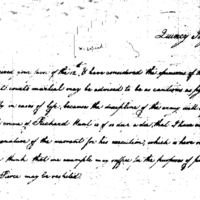
Asks McHenry to urge future courts martial to pay attention to every detail, especially in life or death cases, as the discipline of the army depends on this exactness. Seems to decline to sign the warrant for the execution of Sgt. Richard Hunt, though he states that if an example is necessary for the public justice, the execution of Hunt or Pierce [presumably another convicted man] is acceptable.
Routine correspondence concerning the appointment, transfer, promotion, discharge, desertion, leave, and assignment of individual officers and soldiers
Routine correspondence concerning the appointment, transfer, promotion, discharge, desertion, leave, and assignment of individual officers and soldiers
Reports that Stevens's business is not yet settled; Stevens has written to the Secretary, requesting him to accept the terms or find someone to take his place. The Quartermaster's objections to the Armourer's account are unfounded; Armourers in the field were always under the command of artillery commanding officers or the military stores department or the quartermaster. Reports that the Paymaster General has arrived. Fever has subsided in the city