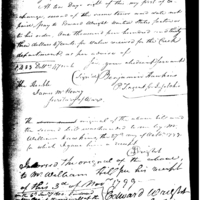
Letter, directs delivery of uniforms, blankets, knapsacks, etc. to Captain W.S. Cockran's Company of the Second Regiment of Artillerists & Engineers at Fort Mifflin.
Routine correspondence concerning the appointment, transfer, promotion, discharge, desertion, leave, and assignment of individual officers and soldiers.
Although he had previously decided to absent himself from military concerns until the troops had taken the field, General Washington addresses the matter of winter quarters for sundry regiments.
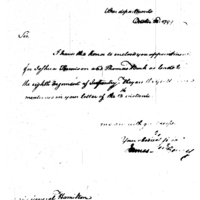
General Washington discusses a number of matters including the disposition of the 8th, 9th, and 10th Regiments, the necessity for General Pinckney's views on these matters, and appointments to the Inspectorate.
Dayton requests payment to Colonel Jonathan Rhea of $5000 on account of Dayton's contract for furnishing provisions to troops of United States in New Jersey.
"The Secretary of the Inspector General [Hamilton] is entitled to the pay and emoluments of a captain. The expression is general. It is not stated in the law whether the emoluments of a captain of cavalry or those of a captain of infantry shall be the rule of allowance. In a case of this kind the construction must be governed by the particular situation of the officer and the nature of the service in which he will be engaged. My secretary will require the use of a horse as it will necessary for him to accompany me in my operations. It is therefore ;perfectly reasonable that he should receive forage and this appears to me tobe the just construction of the law."
Wilkins has written to James Miller to make a settlement of his cash accounts with Hodgdon through December 1798 and includes his remarks. Nothing further is necessary except for Hodgdon to render his accounts from that period up to the expiration of his service.
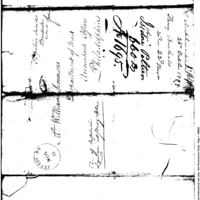
Burbeck informs Simmons of the time of service of Isadore Peltier who worked for several years as a mason on various public works projects for the pay of $2 per day.
Routine correspondence concerning the appointment, transfer, promotion, discharge, desertion, leave, and assignment of individual officers and soldiers.
General Washington discusses his orders for the disposition and quartering of troops during the winter months. He considers the erection of huts more economical than renovating existing barracks. He is disturbed at the reports that money has not been provided to pay the troops since he knows that funds have been appropriated for that purpose.