Hamilton outlines a plan of the locations at which the four permanent Regiments might be established, with the distribution by company for each location.
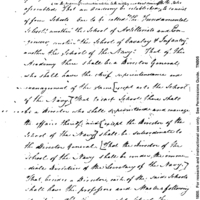
An Act for establishing an Academy for Instruction relative to the Military and Naval Service of the United States. The Academy will consist of four schools: "The Fundamental School," "The School of Artillerists and Engineers," "The School of Cavalry and Infantry," and "The School of the Navy."
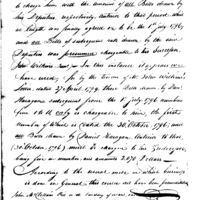
Hodgdon admits to having erred in declaring that all bills drawn on the deputies of John O'Hara, Quartermaster General of the Army, are chargeable to O'Hara prior to his resignation and after his resignation, such bills are charged to his successor, John Wilkins. However, it appears that bills number 1 - 11 are chargeable to Daniel Haragan.
Speech of the Secretary of War to the Chiefs and Warriors of the Potowatomies, Ottawa, and Chippewa Nations. Cited and enclosed in McHenry to Hamilton, 05/18/1799.
Hamilton believes that the Articles of War need to be completely overhauled, which would take some time, and suggests improvements for the interim. There should be greater clarity relating to the power to appoint a general courts martial, specifically giving the President discretionary authority to empower officers other than those designated by the Articles of War to declare a general courts martial. The Commanding General of an army should have the power to decide on sentences. Hamilton addresses possible punishments for desertion, including confinement and labor.
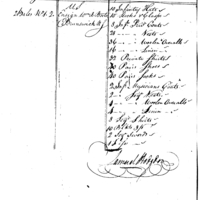
Hamilton encloses a plan for the uniform of the Army, per an earlier request from McHenry. He stresses the importance of proper appearance and complains about the current uniform. He also includes an estimate of clothing needed for the current troops, and hopes that materials for warm winter clothing will be sent as soon as possible.
Instructions for the formation and disposition of a regiment of infantry. Describes the number of battalions, divisions, companies, platoons, sections, and squads. Gives the station for officers and non-commissioned officers in order of battle.
A detailed plan of the formation of a regiment for exercise or battle, outlining the officers for a regiment, the number of each rank, and the breakdown into battalions, divisions, and companies.
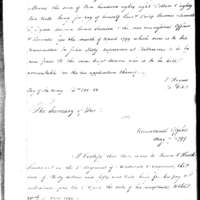
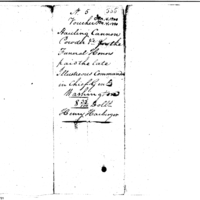
Harbinger acknowledges receipt of $8.33 from John Wilkins as payment for his services hauling cannon and powder used for the funeral honors for General Washington.
Estimation of the value of articles delivered from the Public Store to the order of David Ames, Superentendant for the use of the Armory since December 31st 1798.
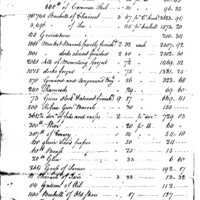
Estimation of the value of all stock on hand at the Armory in Springfield, as recorded by Superintendent of the same armory. Articles include iron, steel, charcoal, socks, musket barrels, ramrods, wire, sandpaper, brass, glue, tar, oil, shoes, candles, lead, skins, salt petre, etc.
Statement of the Armory Department at Springfield for the year 1799, from the paymaster and public storekeeper at the Springfield Armory. Included is a detailed list of supplies and ordnance on hand and work accomplished during the year. The total for the year is $74,086.34.