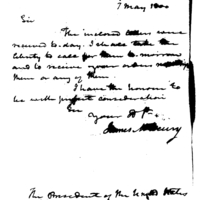
Routine correspondence concerning the appointment, transfer, promotion, discharge, desertion, leave, and assignment of individual officers and soldiers.
The Chevalier mistakenly congratulates Hamilton on his appointment by President Adams as commanding officer of the US Army to replace George Washington.
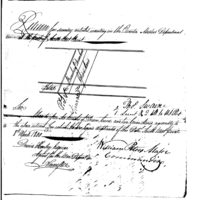
Return for sundry articles wanting in the Quartermaster's Department at the post of Southwest Point. Documents note return of wagon wheels and ploughs for the use of the Cherokee Nation.
Due to a communication from General Wilkinson, it is fixed that the assembling of the reserve corps on the lower parts of the Ohio shall be deferred until Autumn.
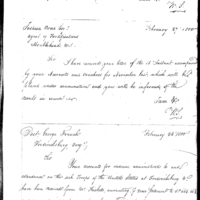
In response to request by Ford, Simmons enclosed copies of provision return records of Capt. R.S. Blackburn. Simmons only included records of the last settlement of William Westwood's account, believing that the sample was indicative of the entire account.
Copy of account transmitted in previous letter. Account shows monies advanced to Preston from Caleb Swan previously omitted from records. As a result, Preston owed United States money, to be paid to Treasurer.
Frederick Claiborne received a credit to his account for sundry payments, however amount left a balance now standing in his debit. Simmons requested Swan deduct the sum from his pay.
Simmons did not take into account Henry's position as commandant when calculating quantum for room hire. Therefore sum owed to Henry which he would receive from Dexter, supervisor at Providence. No allowances were made for compensation for fuel costs due to the regulations issued by Sec. of War.
Williams considered it his duty to exhibit the complaints against Mr. Ames and hoped that a fair and candid investigation would have taken place on the spot. A few days after Ames left for Philadelphia, Williams was surprised to find he had obtained partial depositions and certificates calculated to exonerate him from charges without a fair inquiry. Williams lays out the evidence which shows that Ames abused the system of U.S. apprenticeships and committed other fraud.
Sargent requests a cask of madeira and a cask of sherry which should be selected by Henry Scheaff who is a accomplished judge of wines. He also wants a case of twelve bottles, half filled with olives and half filled with capers. A case arrived that should have contained these articles but instead was filled with cucumbers, already common in the Mississippi Territory so the freight was not justified. He also wants almonds, raisins, tea, loaf sugar, and currants.
In a mostly illegible letter the following can be ascertained: William McIntosh, a brother to Mrs. Sargent and a respectable planter; purchase; infant child; plantation; Virginia land; Allen Crocker of Boston; Congress; wisdom; Mr. Burroughs.