In the event that Brig. Gen. Morgan declines appointment, Knox hoped to appoint Otho Williams. Requests Williams acceptance or declination of possible appointment.
Certified service record of Robert Coakly, who served as private and corporal in 6th Regiment of Light dragoons and earned the approbation of his officers.
Jacob Boone confirms that he sent Samuel Hodgdon - Quartermaster - 100 bags and one keg of shrub for General Wilkinson via Amos Seemer, a contractor, in March.
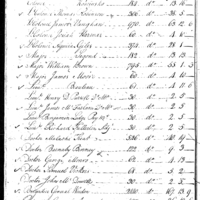
Abstracts of Pay and Rations for Scouts and Rangers employed for the protection of the Frontier counties of the states of Pennsylvania and Virginia. Lists names and counties. Certification that the abstract was examined and compared with returns. All information verified.
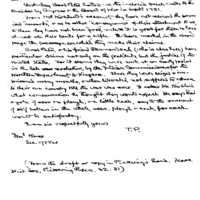
Pickering informs Knox that Good Peter handed him a speech made to the Oneidas by Congress or the Board of War in September 1781. According to the Reverend Samuel Kirkland, Good Peter and his friend Chief Skenandoah [both of whom are present at the conference in Philadelphia], say they have not received their rewards. During the Revolution, Good Peter and Skenandoah were sent to Niagara by the Indian Commissioner for the Northern Department where they were subsequently imprisoned, and did not return home until the end of the war. Kirkland says that as compensation they each want a yoke of oxen, a plough, and $60 cash.
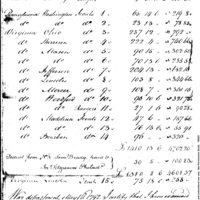
Joseph Nourse encloses papers in which he estimates for Hamilton the monies due to the War Department for the year 1791. The papers are contracts for army rations made with the War Department.
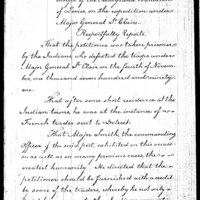
In considering the petition of Samuel B. Turner, Knox wrestles with the question as to whether a prisoner of the Indians should receive full pay and emoluments while in captivity and also be rembursed the amount of his ransom. While refusing to establish a general precedent for such cases, he concludes that the $42 requested by Turner is not unreasonable.
Appears to be a response from the headmen of Five Nations to Colonel Timothy Pickering's invitation to attend conference at seat of government in Philadelphia. The document opens with a reference to a death and ensuing grief. This could be a reference to Colonel Pickering's speech mourning the death of Farmer's Brother's son. Minds were suddenly crushed; a youth was cut down. Drowned in tears and grief pervaded every heart. How many ears might have heard pleasant voice and how many languages in which might have spoken. Great spirit has seen fit to cut down and he is deposited in yonder ground. In closing, they note that the conference will be duly attended by all [except] Cornplanter.
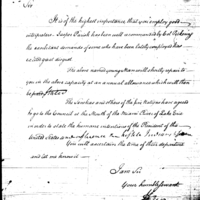
Secretary Knox directs James Seagrove - Superintendent of the Southern Department - to be cordial with the Spanish, and report any troublemakers like Bowles. Wants peace with the Spanish.
Knox refers to the treaty McGillivray and chiefs made with the United States in New York. States that Bowles' presence and his absence have been troublesome, but Bowles has been arrested. Urges him to decide on boundaries with Seagrove; says Americans don't want their land. Says McGillivray's nephew is fine.
Knox tells Alexander McGillivray that he hopes the boundary lines established in the Treaty of New York with the Creeks will be drawn soon so as to eliminate any potential for misunderstanding. As for the northern Indians, if they are not responsive to U. S. attempts to establish peace and continue their violence on the frontier, war is inevitable.
Three extracts; the first, dated 4/8/1790 to Henry Burbeck, requests that he and his men display friendly relations with the Spanish at the Spanish garrison. The second, dated 4/29/1792 instructs James Seagrove to report to the Spanish any man or activities which would be harmful to the interests of peace with the Spanish government. The third, dated 8/11/1792 to Henry Gaither, instructs that officers on the river St. Mary are to conduct themselves with politeness to the Spanish.
Knox expresses to General Israel Chapin the wish of the President for an accord with the western Indians. However, if every effort is made by the United States to pacify the Indians and depredations on the frontier still continue, war will be inevitable.