Colonel Hull writes to Knox that he will be unable to accept the appointment Knox has offered, as his father in law, Judge Fuller, is ill, and is solely dependent on Hull to take care of his business.
Britt entitled to further sums to pay sundry scouts, militia, and rangers called out for the defense of frontiers of United States and Pennsylvania and Virginia.
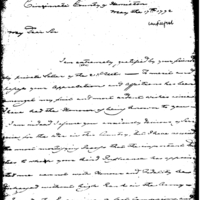
Knox informs Hull of his promotion to Brigadier General. Has not received word of acceptance. Has ventured to assure President Washington that Hull would certainly accept.
A talk by James Seagrove to the Creek kings, chiefs, and warriors in which he exhorts them to cease the bloodshed, return their prisoners, and preserve the peace between the Creek nation and the United States. He promises that the U. S. will conscientiously carry out all the terms of the Treaty of New York.
The Secretary of War requests that Knox purchase from James Morrow any of his armorer's tools that might be fit for service. They are to be appraised by an impartial man previous to payment.
A talk delivered by James Seagrove from the President in which Seagrove excoriates the subversive activities of William Bowles and warns the Creeks that attacks upon innocent Americans will be dealt with harshly. He assures the Creeks that the terms of the Treaty of New York will be met and boundary lines established as agreed to in the treaty.
A talk delivered by James Seagrove, Commissioner of Indian Affairs, to the Kings, chiefs, and warriors at Rock Landing in which he exhorts the chiefs to stop the bloodshed, surrender their prisoners, and preserve the peace.
Craig believed waggoners stopped over at their homes to plant corn while transporting cannons and sheet iron. Delay in transport has caused delay in production of camp kettles and other goods. Capt. Hughes and troops occupy barracks at new fort.
Governor Blount creates for General McGillivray a long list of murders, horse stealings and other depredations by the southern Indians, particulary the Creeks and Cherokees. He has been informed that William Bowles may be the mastermind behind these atrocities.
Letter to Secretary Knox regarding the rank of Adjutant General and Inspector of the Army. Also discusses army discipline. Cannot discharge duties without higher rank in Army.
Despite hopes for peace, Governor William Blount of Southwest Territory sends Knox a letter describing the murder of two young boys by Indians and an extract from General Pickens referring to murders and horse stealing by young Indian warriors that are provoking the frontier settlers. Blount believes that the murder of the boys was by southern Indians since northern tribes rarely venture so far south.
General Hand writes Secretary Knox on the shipment of rifles, which are packed and awaiting a wagon to transport them. Not all of the rifles were acceptable, but more are expected.
Secretary Knox discusses with the Governor of Virginia the militia call up and pay, along with the protection of Virginia's frontier. President Washington will concur in every reasonable measure for the defensive protection of the Southern frontier of Virginia. He is impressed with conviction that all parts of the Union ought to be defended at the general expense.
Moylan hopes to meet the official guard for their safe conduct to Fort Washington. He has been particular in the choice of horses in the hope that they will be adequate for the expedition.
Knox informs Washington that the meeting with the Cherokees went well although the Indians complained about the behavior of the frontier settlers. So far, the prospects for peace in the northwest appear favorable.