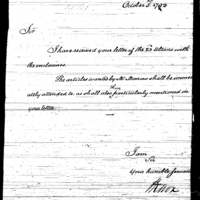
Knox praises Wayne's use of patrols--instead of small garrisons--as a means of protecting the frontier. It is hoped that the people also recognize the effectiveness of the patrols and not feel the need to call on state militias to protect them, a step that would add unnecessary expense for the general government.Currently it appears that 2500 recruits will be added to the Legion by January.
Enclosed is Dorsey's bill for load of sugar and coffee, forwarded by Anderson, the bearer of the letter. Respectful compliments to General Nevil's family and Mrs. Craig.
Cited in Knox to Wayne, 10/12/1792.
Capt. Jonathan Cass was relieved from his command at Fort Franklin by Capt. Hughes and is now on his way to Philadelphia to await recruiting instructions and money from Knox. He will provide Knox with information relating to the disposition of the Indians and the number that have gone to meet the hostile tribes. Wayne is sure that there will be no peace save that achieved on the battlefield, unless a boundary line which excludes America from the Lakes is agreed upon. Wayne will wait to elucidate the true reason why the posts on the Lakes have not been delivered up agreeably to the treaty.
Relayed results of council meeting with Cherokee and Creek chiefs. Both Nations declared intention of peace. Advised friendly relations with peaceful towns. Also informed frontier inhabitants of 500 Creeks that just passed Tennessee river, joined by 100-200 warriors en route to Cumberland.
Knox discusses the problems and potential solutions to conflict with Native Americans with Rev. David McClure of Dartmouth College. Knox expresses moral opposition to fighting Indians.
Notified Blount that there were Indians poised to attack. Kenoteta offered supplies to U.S. if they pass through his territory. Talahuske says he abandoned his war talks, now seeks peace but Kenoteta believed he was lying and advised Blount against any sense of security.
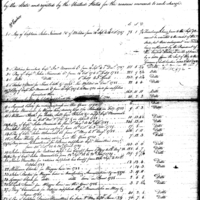
An abstract of charges made by the State of South Carolina against the United States for expences incurred in the protection of the frontiers as extracted from account no. 3 rendered by the State and rejected by the United States for reasons annexed to each charge.
Discusses inventory of shells and shot. Mr. Campbell has sent a man to clean and trim the shot. Mr. Morrow, the armorer, complains about not receiving a barrel of oil. Craig lists a number of articles that have not been received. Also encloses list of damaged goods.
In response to a complaint by a militia officer, Wayne explains all the measures he is taking to ensure the safety of the frontier, including the use of frequent and multiple patrols to intercept any marauding Indians.
A Treaty of peace and friendship, made and concluded between the President of the United States and the undersigned kings, chiefs, and warriors of the Wabash and Illinois tribes.
Enclosed information on J. Deraque and R. Finnelson given under oath witnessed by R. Hays, justice of the peace. Also discussed change in attitude of Indian chiefs and how to obtain men for service in military. Believed Gen. Pickens a good choice for officer to command troops against Indians.