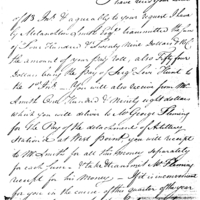
Has returned from scouting a winter site for the army; must wait for water to rise (for ease of supply) before relocating there. Refers to retention of interpreters. Capt. Pierce will soon arrive from Philadelphia with 192 noncoms and privates; complains that Capt. Eaton "of whom we have heard so much" has brought only 44 noncoms and privates, and that all arriving detachments thus far have had the same problem. Affirms hostile views of the Indians, and hopes all ideas of peace will be done away with, that the Legion may be more quickly assembled and allowed to do its job.
Knox urges Wayne to use whatever measures are necessary to eliminate excessive expense. Perhaps the use of oxen instead of packhorses would be one way to save money. A significant number of recruits is being marched from Virginia and Maryland to Pittsburgh to join the Legion.
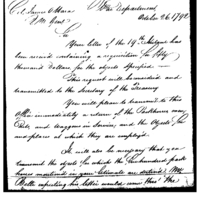
Requisition for $50,000 will be considered and transmitted to Treasury. Asks for returns of pack horses, oxen carts, wagons in service, and object for which employed. Asks for an abstract specifying objects and amount of payments made.
Copy of contract between Alexander Hamilton and William Young and George Dannacker, contractors, for supplying clothing to War Department for the Army. Describes procedures for inspection of quality. Schedule of articles are for infantry and cavalry.
Letter, discusses frontiers and pioneer life; discusses Indians and Indian life; mentions publication on moral law; discusses racial intermarriage and Christianity to civilize Indians; discusses race issues. Proposes focusing on children, particularly boys, and immersing them in white culture. Mentions Indians in New England.
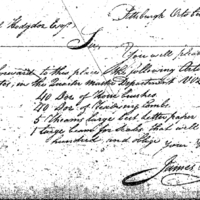
O'Hara requests $50,000 for the Quartermaster's Department. Post notes in his name would be the safest way to transmit same by carriage. There is a need for money in small denominations. Gold regulated would be preferred, along with silver, but if it can't be sent, send a complete set of scales by which O'Hara can have it regulated. Letter paper used by the War Department is also needed.
O'Hara asks that the following articles be purchased for the Quartermaster's Department: 40 dozen horse brushes; 40 dozen readying combs; 5 reams of large letter paper; one large beam for scales.
Cited in Knox to Wayne, 10/26/1792.
Wayne is gratified to learn that Governor Blount was merely alarmed by the report of war and not more seriously affected. He worries about the safe return of Chief Cornplanter; according to the deposition of William May and intelligence gathered from the Indians, there is much evidence that some premeditated mischief is intended to be carried out against Cornplanter.
Wayne provides dispatches that he recently received, one of which provides a circumstantial account of General Wilkinsons second tour to the site of General St. Clairs defeat. He informs Knox that Major Rudolph headed down the Kenhawa River with needed clothing, arms, and accoutrements for the soldiers at the mouth of the river. Waynes time of late has been spent preparing for the move to winter quarters.
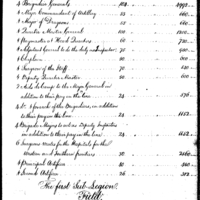
Wayne remarks on the latter part of a letter from the President discussing the redistribution of the Sublegions, and Waynes notion that neither possesses a solid skeleton. There are not more than 1100 men, excluding those who are sick, and the actual number fit for duty is 824 men. Wayne feels it would be very difficult to find a Sublegion for Marietta without raising more effectives for the Legion, and so this needs to be a priority.
Wayne also encloses an extract from a letter written by Mr. Belle which reveals he is too optimistic about the price and feasibility of procuring forage in Kentucky and transporting it to Fort Washington.
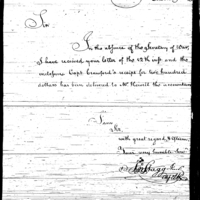
In Knox's absence, Stagg writes of a sergeant who was given permission by General Wilkinson to desert in order to gather intelligence related to Indian intentions and movements. President Washington interrogated this man in Stagg's presence and sent him on to Pittsburgh to meet with Wayne.
Hawes discusses the settlement of his private account and claims that he should have the same half-pay as other officers, having served for seven years.
Mr. Hall writes Howell of the Pay Office detailing various experiences in South Carolina and Virginia, mentioning Lafayette and Cornwallis. Letter is highly illegible.