Stagg reports that Captain Constant Freeman is so engaged that he cannot attend. Both the Secretary of War and Secretary of Treasury have no objection that William Knox inspect the 50 suits of clothing of Billington and Young bound for Captain Jonathan Cass of Exeter New Hampshire.
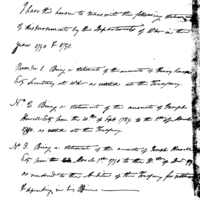
Report on Disbursements by the Department of War submitted to the Speaker of the House of Representatives [Frederick Muhlenberg] by Alexander Hamilton, Secretary of the Treasury.
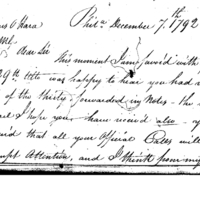
Discusses the forwarding of money; should not suffer any inconvenience for want of money. Remembers the spot that O'Hara describes and notes its beauty.
Though it looks as if the peace council has failed, it is still mandatory that no offensive operations against the Indians be undertaken north of the Ohio River. Friendly Indians, such as Wyandots and Delawares, should be welcomed although with a watchful eye. Contractors must be held responsible for defective or stale stores and magazines for their stores should be located near military posts and not at a distance simply for their convenience.
Stagg requests that Hodgdon have packed up for Captain George Fleming at West Point, and forwarded by water to New York: 20 suits of infantry clothing complete for 1 sergeant, 1 corporal, and 18 privates. Address them to can of Melanton Smith Esquire, of New York
Stagg orders Lt. Morris to the City of New York where he will recruit for the Legion of the United States. The men he enlists will be sent to West Point and assigned to Capt. Bezaleel Howe.
There is no recent information on the results of the peace council but Knox is certain that there will be no agreement that damages the good name of the US. There are to be no advance posts in Indian country until treaty negotiations are completed. Arrangements have been made to provide clothing for deserters and clothing for next year.