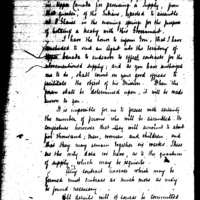
Secretary Hamilton writes that supplies are to be procured through upper Canada. Agent to be sent to negotiate contracts for supplies for the purpose of obtaining a treaty with the government. Includes copy of speech from John Graves Simcoe to General Council of Indian Nations.
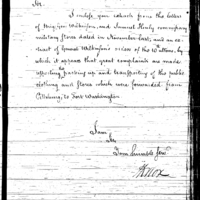
Extracts from letters of Brigadier General James Wilkerson and Samuel Henley, commissary military stores and extract of General Wilkerson's orders. Appears there are great complaints on the packing up and transporting of public clothing and stores from Pittsburg to Fort Washington.
The Indians continue to demand that the United States withdraw to the south of the Ohio River. There is a severe shortage of officers; non-commissioned officers are now in posts which should be held by commissioned officers. The men have not been paid for five months and need the money to purchase clothing for the winter.
The Commissary of Military Stores discusses requests for money. Expresses happiness that General Anthony Wayne and his troops are comfortably quartered. Expects army to operate early in spring. Believes that no terms will be accepted by Indians unless they are given a sound drubbing. Makes mention of events in France. Remarks with "chearfulness" at news of the French Revolution; condemns the "tyrants" who have been overthrown in France.
Knox responds to a complaint regarding stores of clothing that never reached the Legion. He assures Wayne that every precaution was taken to ensure that the clothing was delivered appropriately. Complaints regarding the delay in pay for the troops are also addressed.
New Arrow and Cornplanter discuss their mission to convince the Western Indians to meet with representatives of the United States so as to reach a peaceful settlement of the differences between the Indians and the Americans. The Western Indians point out that they were on the American continent first and consider the whites their children.
Secretary of Treasury Alexander Hamilton prescribes forms, policies and procedures for keeping and rendering public accounts related to the Indian Department. Hamilton requests strict observance by the particular superintendents of the several departments. There is no quarter in which there is greater danger of abuse; proportional care and exactness are called for.
"The President of the United States has directed me to submit to the Senate the copy of a letter from his Excellency the Governor of Georgia, dated Augusta, December 5th, 1791, with an enclosure relatively to Indian affairs in the southern department."
Encloses return of shot and shell received of Messieurs Patrick and Torrence Campbell. Reams of paper insufficient. Armorers are in need of oil, which is very expensive at Pittsburg post.
Knox warns Wayne that the memorial of the officers regarding the sufficiency of rations is considered by the President and others as an improper gesture that might result in insubordination and other military evils.
Knox expresses the President's regret that a communication regarding rations was initiated by the officers and men of the Legion rather than by Wayne himself. A statement by the commanding general is given the same weight as if it were from every man under his command. Pay has yet to be forwarded and awaits the appointment of a man suitable for this responsibility.
Highly confidential letters from Wilkinson to be transmitted to Wayne. Proper methods for assembling officers discussed. Mr. James Seagrove made amicable agreement with Creek Indians.
Secretary Knox transmits letter from John Belli. The defeat of Arthur St. Clair defeat has inclined him to make large drafts of money. Notes that this is irregular and the drafts should have been upon O'Hara. O'Hara is Quartermaster General.