The President has inspected the letter to Governor Blount and it meets his approval but he would like to have the enclosed included in a postscript or in the main body of the letter.
The money Howell had advanced to the accounts of Dr. George Balfour and Dr. Charles Brown, being deducted from his estimate, cannot be considered as money in Swan's hands to be appropriated to their use until Howell's payment is deducted.
John Stagg Chief Clerk inquires to what amount Mr Belli has drawn bills; which have Hodgdon accepted; and asks what sum of above for which no letter of advice have been received. Purpose is to inform James O'Hara, Quartermaster General.
Secretary Knox asks the Quartermaster General for more punctual settlement of accounts. Notes that nothing will excite more dissatisfaction and uneasiness than a protracted settlement. Mentions that for John Belli to draw money, it must pass through O'Hara.
The contractors lament that they are injured by detention of money from public in consequence of accounts being unsettled. Writer goes on to describe pricing. Auditor has consented to allow the account.
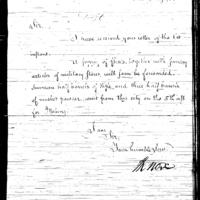
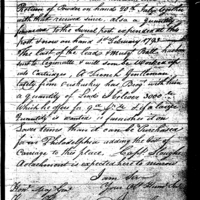
Encloses return of powder. Lead and musket ball sent to Legion Ville and will soon be worked up into cartridges. Mentions a Frenchman from Sandusky offering lead for good terms when considering the cost of carriage from Philadelphia. Captain Slough's detachment expected tomorrow.
Wayne provides a detailed accounting of his army's use of ammunition, powder, and lead for four months and warns that he will need more of each when the weather becomes warm enough to practice firing.
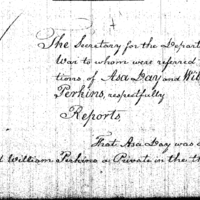
Knox reports on the petitions of Sergeant Isa Day and Private William Perkins who were in the Third Massachusetts Regiment. Arrears due them for pay were placed in hands of the Regimental Agent, who became bankrupt. Mentions the petitions of Thomas Hurrt, John Fox, and Henry Bacon as being the same.
Journal of the commissioners of the United States appointed to hold a treaty at Sandusky for the purpose of making peace with the Western Indians. Commissioners: Benjamin Lincoln, Massachusetts; Beverly Randolph, Virginia; Timothy Pickering, Pennsylvania. Two commissions outlined. First gives the commissioners full power to confer, conclude and sign with such persons of Indian nations a treaty of peace between United States and said Indian nations. Second, commission states that the powers are held or retained by those commissioners in the event of sickness, death, or nonattendance of another.
Minutes of a conference held at Henry's Station on the 6th of February 1793 between Governor Blount and John Watts, the Hanging Maw, Double-head, and many others of the Cherokees--Susanna Spears, interpreter.