Requests that commissioners be informed of all treaties & boundaries with northern and western Indians. Refers to Indian lands ceded or purchased to the U.S., questioning to which tribes the land "belonged" and how to draw appropriate boundaries. Seeks truce between young Indian warriors and United States military for the next five to seven years.
Governor Lee concludes that since peace appears to be at hand with the southwestern tribes, it will not be necessary to call additional forces into service.
Report to the House of Representatives on the causes of the failure of the expedition against the Indians in 1791, under the Command of Major General St. Clair. This part of the report focuses on the alleged neglect and mismanagement of the Quartermaster's and military stores' department.
Townsend reports on the treaty negotiations with the Creeks of the lower towns which are complicated by the machinations of the Shawanese chiefs and William Bowles.
Since peace with the Indians is not likely, Wayne has decided that the best method of transporting stores and forage westward is by wagons pulled by teams of oxen and provides an accounting of the money saved by using this method instead of pack horses.
Knox conveys the President's reluctant acceptance of General Putnam's resignation and thanks the general for his successful pacification of the Wabash Indians.
Putnam descirbes his meeting with friendly tribes at Vincennes where the Indians were given clothing, blankets, and ornaments to confirm the friendship of the American government.
Peter Frothingham has written to Putnam requesting a commission in the Army. Frothingham's brother is reputed to have served bravely with Harmar and Peter's appearance is in his favor but Putnam does not know whether he has any military experience.
Refers to letter from Lieutenant Governor of Virginia; asks for execution of payment of specified demands. Lee then asks for information on Indian Wars in order to make preparations, to include the prospect of calling up men into service;
Putnam explains that the chiefs did not express themselves clearly at the council. The alleged sale of land to Louis Viviatte was not valid because it was made by those who had no authorty to sell.
The depredations in Mero District appear to have been committed by the Creeks with the aid of the lower Cherokees. John McKee has been dispatched to meet with the chiefs of the lower towns with the mission of reestablishing peace. He has been given Indian articles to present to the chiefs to persuade them of his good intentions.
For the use of the Quartermaster's department, Belli has drawn on Knox the sum of $242 for Thomas Gibson and $1021 for Robert Barr. The total sum of $1263 Knox should honor with payment.
Knox questions whether the fourth article of the treaty with the Wabash Indians makes it possible for any power other than the United States to buy Indian land.
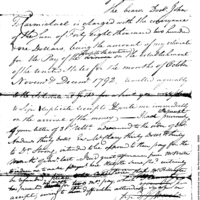
The bearer, Dr. John Carmichael, is charged with the conveyance of $48,201, being Howell's estimate for the pay of the troops to the westward for October, November, and December 1792. Howell asks to be notified immediately upon the arrival of this money.
Knox has determined that the money shall go forward to D. Carmichael. Asks that Hodgdon engage someone to accompany Carmichael, well mounted and armed.
Putnam assures Knox that neither he nor the Indians at the council at Vincennes ever considered that they had a right to sell their lands to any other power than the United States.