
Collection
Transcription Project
-
Payment to Captain Thomas Blackwell
Payment Captain Thomas Blackwell of 10th Virginia Regiment. -
Account of Captain Thomas Blackwell
Shows payment of $1200 to Captain Thomas Blackwell, 10th Virginia Regiment from Jonathan Hudson, Deputy Paymaster General at Baltimore. Included Is $800 for payments for two parties of men inoculated in 1777. -
Certificate for Sergeant John Straum
Certificate number 658 for Sergeant John Straum, late quartermaster in Colonel Lee's Legion. -
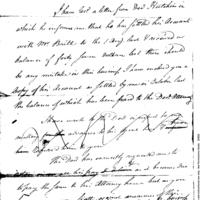
Account of Doctor Hutchinson
Dr. Thomas Hutchinson has informed Howell that he has settled his account with Mr. Britt through August 1, 1792 and received a balance of $45. Lest there be a mistake, Howell has enclosed a copy of the account as settled by him in October, the balance of which has been paid to the doctor's attorney. -
Allocation of Public Stores
Allocation of public stores discussed. -
Payment to soldier's wives
Two of the men whose wives have drawn pay from Howell have been careful to anticipate all the pay due them from their officers but the officers have informed Swan that they will put them under stoppages in the future until Howell's requirements are satisfied. -
Knox's Letter to the Western Indians
Knox says he has heard the voices of the Sachems, Chiefs, and Warriors and received their messages through the Six Nations. The President of the United States embraces their proposal and will send Commissioners to treat with them. The United States will endeavor to supply provisions during the Treaty. He warns that it will be in vain to expect peace if the depredations continue. (Given by order of the President of United States.) -
Letter from James Seagrove to the White Lieutenant, of the Oakfuskies
Letter from Creek Indian Agent James Seagrove to Chief White Lieutenant of the Oakfuskies. Received a talk from White Lieutenant through medicine of Mr Townsend and Mr Timothy Barnard (interpreter). Seagrove notes that White Lieutenant had not received his letter or present of silverware. Seagrove speaks highly of the Chief. Reports that the great and good father General Washington has high regard for the Chief; considers him one of his best friends in the Creek land. Regrets that the Chief was not invited to the meeting; it was a miscommunication; certainly not intended. No doubt the chief has heard about talks to Chief of Creek Nation during past November. Mr Barnard is to explain all the talks. Horses have arrived via Mr. Fowler and Mr Reilly. When Fowler returns, will send more presents. All is peace and friendship in this country toward the Chief and his people. President Washington will make Chief's people happy and comfortable as long as they act well by him. Sorry that the Creeks allow villains from northern tribes to come into their lands and give talks which cannot fail to bring ruin to Creek people. Northern tribes have been carrying on war for some years; General Washington wished for peace; that is why he did not send a large army to destroy them; and that is why they had an opportunity to kill some of his people and do a great deal of mischief [St.Clair and Harmar defeats]. Washington sent commissioners to offer peace; they were murdered and this angered him much. As such, he ordered great army of choice Warriors to go against them. This army [presumably General Wayne's] is ready and will march into towns when snow is gone. These tribes now beg in a most humble manner for peace; chiefs are going to the president and congress in Philadelphia. Warns the Creeks not to get involved; like a drowning man, northern tribes will pull anyone down to save selves. Advises chief to drive them from land. Seagrove will give presents to those who bring northern Indians to him (a horse load of goods). Seagrove regrets he did not come sooner, but path is bad and no feed for horses. -
Letter from James Seagrove Creek Indian Agent, to leader of Courtas [Courlas] warning of the northern tribes
Letter from Creek Indian Agent James Seagrove to leader of Courtas [Courlas]. Reports that great and kind father General Washington, President of United States is pleased to hear of the peaceable conduct of his Creek children. Glad to hear the talks of upper towns continue good. Will be at Cussetah 1 May, where talk will be straight. Beware of the northern Indians giving bad talks. Chiefs of north see great U.S. Army and now want peace. Great father Washington will take pity on them and will not destroy them, though they have been very bad; deserve to be punished; but [Washington] is kind and merciful. Continue to give your people good talks; keep them straight. Mr Bernard will deliver this. Please assist and befriend him and Mr. Holmes. Pay attention to what they tell you. -
Letter from James Seagrove to Fine Bones, Chief of the Broken Arrow
Seagrove acknowledges receipt of talks brought by John Galphin. He assures Fine Bones of his commitment to keep the path clear between Fine Bones' people and the United States. He notes that the future happiness depends on friendship with the United States. Seagrove reminds Fine Bones that he will meet with him on 1 May 1793 at Cussetah. Here he will hear his talks. He advices Fine Bones not to listen to the Chiefs of the Northern Tribes, who are now begging for peace with the United States. Advises to stay away from the Shawnee. Apologizes that he did not seen him at St. Mary's in November. Send some horses and Seagrove will return them with presents. He sends elegant arm bands which come from the great father George Washington. Closes by saying he will be to Fine Bones' country men as John Galphin was your real friend. -
Letter from James Seagrove Creek Indian Agent, to David Cornell on his bad actions owing to the wicked advice of white me
From St Mary's, Seagrove says that David Cornell's actions [bringing a scalp from Cumberland at behest of Spanish Agent] are indeed bad, but are the fault of the wicked white men [Spanish Agents]. Seagrove expresses great regard for Cornell's father. Advises him to take the advice of his cousin Alexander. Will see Cornell when he visits the Cussetahs on 1 May 1793. -
Letter from James Seagrove to Indian Interpreter Alexander Cornell
Letter from Indian Agent to the Creeks James Seagrove to interpreter Alexander Cornell. Seagrove received a letter from John Galphin, who is a wealthy Creek of mixed blood. Seagrove is pleased that the Creek people take his talks as they are intended and dictated from purest friendship. Seagrove asks that Cornell exert himself in all his power to prevent the Creeks from talking with the Shawnee or other northern Indians. Indian commissioners are now in Philadelphia with General Washington in hopes of getting a peace. The northern tribes now see a great Army and now ask for peace. Seagrove will give a horse load of goods in exchange for a northern Indian brought to him, and half that amount for a dead one. Seagrove is sorry to hear that the Creeks may be involved in a war with the Chickasaws, but assures the Creeks of United States support. Seagrove hopes that Cornell has seen the White Lieutenant and the Mad Dog and given them his talks. He pledges on behalf of father Washington, peace and friendship until the end of time. He closes by asking that Cornell give good advice to David Cornell, for he is wild [presumably referring to his bringing of a scalp from Cumberland at behest of a Spanish Agent]. -
Letter from James Seagrove to the Chiefs and Headmen of the Cussetah and Coweta Towns
Letter from James Seagrove to the Chiefs and Headmen of the Cussetah and Coweta Towns, dated St. Mary's, 20 Feb. 1793. Seagrove writes to inform the Creek leadership that he will meet with them 1 May; and that the talks from the great father General Washington, President of the United States, are straight and good towards Creeks. Seagrove admonishes Creek leaders not to listen to the northward indians, or Chicamagua, as they will lead the Creeks astray. Seagrove notes that the Northern Tribes of Indians, having faced a great army [U.S.], have sent chiefs to General Washington to beg for peace. General Washington, because of his great goodness, may spare these people, even though they don't deserve it. Seagrove has heard rumors that some endeavor to lead the Creeks into trouble, but notes that he believes that Creeks have too much sense to be made fools by bad people. There are Shawnees among the Creeks who show white man's scalps to the Creeks. Seagrove advices that out of regard for General Washington, that they make prisoners of the Shawnee. He offers a reward to those who bring him Shawnee prisoners. Mr Barnard waits on the Creeks with detailed instructions from Seagrove. Seagrove closes by sending his love to the Creek people and asks to be regarded as their true friend. -
Payment to Patrick Lammons
Payment to Patrick Lammons, late private in the 10th Virginia Regiment. -
Letter Citation
Cited in Howell to Dayton, 05/28/1793. -
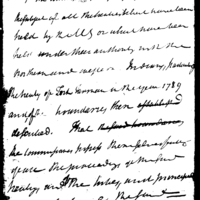
Knox drafts proposed instructions to Indian Commissioners
Document, Draft Memorandum containing proposed instructions for U.S. Commissioners of Indian Affairs. -
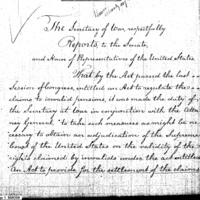
Act to regulate the claims of invalid persons
Discusses adjudication by Supreme Court on the validity of the rights claimed by invalids under the act entitled "An Act to provide for the settlement of the claims of widows and orphans, barred by the limitations heretofore established, and to regulate the claims of invalid pensions." -
Receipts and Bank Notes for troops of United States under Major Gaither
Receipts and Bank Notes for troops of United States under command of Major Henry Gaither. -
Receipt & Forwarding to Congress of Highly Important Information
Wayne is sending to Knox the deposition and papers of Joseph Collins that provide secret information of such consequence that they should be made available to Congress. -
Letter Citation
Cited in James O'Hara to Hodgdon, 02/24/1793. -
Pay of Colonel Gunn
Colonel Gunn informed Howell that Hopkins has refused to pay Gunn for want of a certificate from Howell. Howell says that it does not appear by his books that he has any monies to account except what can be secured to the United States in settling Gunn's account for depreciation. Therefore, Hopkins is at liberty to comply with wishes of Gunn. -
Captain Adair's Account
Howell has examined the rolls of Captain John Adair's militia discharged by Swan, but their entry in Howell's books is suspended for want of the warrant of the commanding officer drawn on Swan for this money, as required by Comptroller of the Treasury. -
Contract for Provisions
U.S. cannot assume contracts or costs associated with them as entered into by Virginia. -
Power to Convene Courts Martial
Knox advises Wayne to provide General Wilkinson with the power to convene courts martial. Dr. Carmichael is en route with the pay for the Army. General Putnam has resigned. -
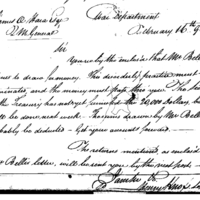
Disorderly process of drawing for money
Secretary Knox is upset that John Belli continues to draw money. This disorderly practice must be discontinued. The money must pass through O'Hara, the Quartermaster General.