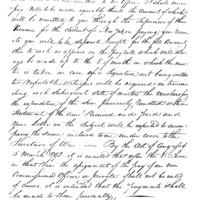
Benjamin Mifflin, writing as acting accountant for the War Department, writes to Caleb Swan acknowledging Swan's receipt of the cash remitted to him through Doctor Carmichael. Mifflin includes in the letter the continuation of the abstract warrants drawn by the Secretary of War as well as a list of payments made by the sundry men of the late Captain Walls' company. Mifflin notes that the same amount has been deducted from the company's pay since arriving at headquarters.
Howell expresses his frustration at the amount of information missing from Swan's account. The payrolls of Major Adair's militia are not included as is much of the information required for the account of the troops subsequent to January 1st, 1791. Mr. Britt has not even listed his advances to Captains Pratt and Kersey for 1791 and 1792.
Upon approval of the President, the howitzers requested by Wayne will be provided. The President has appointed three Commissioners to negotiate with the Indians.
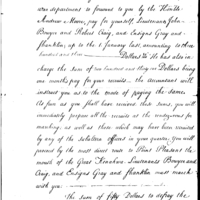
Secretary Knox orders Captain Preston to proceed to Point Pleasant, the mouth of the Great Henhawa River. He is to meet with Major General Anthony Wayne for further orders, then proceed with Lieutenant Bowyer, Lieutenant Craig, Ensign Gray and Ensign Sanklin.
Responding to the President's inquiry regarding William Smith's application for changing the form of the debt to France, the four Cabinet members agree that the government has made payments to France consistent with prior arrangements and sees no need to respond to Smith's application.
This is an extract of an Act of Congress that declares that no purchase of Indian lands shall be valid unless pursuant to the Constitution. Therefore, it is illegal for anyone but lawful agents to negotiate treaties for land.
Major Craig announces the arrival of Doctor Carmichael and Mr. Woods to Samuel Hodgdon. Major Craig asks Hodgdon for a tea table set of china for Mrs. Craig.
Dr. Carmichael has arrived at Legionville with the cash. The packages of silver have been packed and repacked and some of them were mixed before Dr. Carmichael took charge of them in Philadelphia (as the doctor says). The saddlebags with the bank notes have also been delivered.
Wayne explains that General Wilkinson is authorized to render decisions in Courts martial except in capital cases involving an officer or in cases in which an officer might be dismissed from the service. The General Return for the month of February is enclosed with the prospect that a General Return for the Legion of the U.S. will be forthcoming. He is still awaiting orders for the movement of Col. Proctor's forces.
Knox and Hamilton send their opinions regarding the oath of office to Washington. Letter, encloses opinions about the time, place and manner of the President taking the oath of office.
President of United States, with advice and consent of senate, has appointed Posey a Brigadier General in the Army of United States. Asks to signify acceptance. Encloses pay, rations, and emoluments.
President of United States, with advice and consent of senate, has promoted Sedam to Captain in 1st Sub Legion in service of United States, vice Captain Montfort, killed 23 April 1792.
Secretary Knox discusses treaty proceedings and the error in designating the place of treaty, attributable to interpreter error. Mentions Canada Governor Simcoe and his passage of the United States Commissioners from Niagara to Sandusky. Advises to keep the peace with the British in Canada. States "the United States are at perfect peace with the British Government."
"I enclose you a copy of the President's note of this morning and also two letters from Governor Blount--one dated the 24th of January and the other the 1st of February and also a letter from General Sevier of the 6th of February 1793."
Washington asks the four members of his Cabinet to provide their opinions as to the time, place, and manner in which the President-elect [i.e., himself] should take the oath of qualification.