
Collection
Transcription Project
-
Paid Twelve Dollars
Webb paid twelve dollars by check on the bank on the 20th of March 1792. -
Vandenbrock asks a favor of Langier
Letter, ask Langier to pick up his pay at the War Office -
Dispositions of the Cherokees and Creeks
Mr. McKee has not been able to convince the Cherokee chiefs to come to Philadelphia nor was he able to obtain assurances of the peaceful disposition of the young Cherokee warriors. His report will demonstrate, however, the hostile intentions of the Creeks toward the Cumberland settlers. -
Pay of Scouts in Pennsylvania
Swan lists the counties in Pennsylvania that have been authorized to employ scouts and specifies the number of scouts for each county which has been limited to no more than eight at five to six dollars per day. He is not aware of any plan for paying those scouts employed in Kentucky. -
Account of Alexander Dow
Certification of pay and service for Alexander Dow -
Clothing for Captain Lyman's Men
Captain Cornelius Lyman, stationed at the recruiting rendezvous at Springfield Massachusetts, needs clothing. Hodgdon is directed to forward him by way of New York forty suits of infantry clothing for four sergeants, two musicians, and 34 privates. Hodgdon should also forward to Melancton Smith an order for 160 pairs of shoes. The clothing should be sent to Chauncey Whittlesey at Middletown Connecticut who will forward it to New York. -
Letter from Timothy Bernard to James Seagrove Creek Indian Agent regarding white settler encroachments
Letter from Bernard at Flint River to Creek Indian Agent James Seagrove. Reports on complaints by Indians regarding encroachments by white settlers in Georgia. Gangs of cattle driven into Indian territory vicinity fork of Jullah Packa. Bernard relates attempts to stop encroachments by informing commanding officer and Governor of Georgia. Wrote to Captain Phillips. Some Indians may have given permission to drive cattle on land. Received response to letter from Major Gaither. Reports white encroachments, hunting with fire and rifles and dogs and destroying game. No game to be found now. If whites don't stop, Indians will kill them. Cowetas have stolen horses. Matters will not be settled with such headstrong settlers. Says he is in no danger except from the Choctaws below. The Cowetas have gone to do mischief. Held a meeting with headmen of upper Creeks, who want peace. Most in lower area also inclined for peace except Cowettas and Broken Arrow, some of Chehaws and Ousauches. Mad Dog and Chief of the rest of the heads want to see Seagrove as soon as possible. Some Indians starving from lack of game. Notes rascals as the followers of Bowles and Willbanks. Willbanks is missing. May not be found, since Spaniards have reward out for him. Asks that Seagrove bring some provisions, which are hard to come by. Talked with the Prince, may be useful if given good present and good talk. Says he is doing all the interpreting since Darouzeace has rheumatism. Has heard from West Florida that McGillivray is dead; has been interred at Mr Panton's garden. Kinnard wants Seagrove to know he has done everything he can to reconcile matters. -
Estimates for Cash
Encloses estimate of cash required at the Quarter Master's Department, according to request of the Commander in Chief. Promises readiness of estimate as promised. Expresses expectations for Hodgdon to procure money and to make estimate official. -
Letter Citation
Cited in Knox to O'Hara, 04/06/1793. -
Regarding Knox's Request for Interpreters for Sandusky talks
Provides recommendations on interpreters. The man Hodgdon recommended has gone to Kentucky. Mentions Joseph Nicholas, an interpreter of several Indian languages. Craig will ascertain his abilities, and send to Knox if qualified. Encloses invoice of stores. -
War Between the Chickasaws and Creeks
Following the brutal murder of a Chickasaw brave by a party of Creeks, Blount assesses the potential for war between the two southern tribes. -
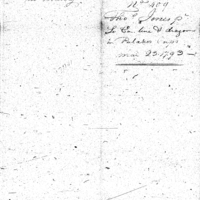
Account of Thomas Jones
Certification of pay and service for Thomas Jones, late of Pulaski's regiment of light dragoons. -
A Widow's Request for Mr. Gilmore's Pension
Howell is informing Swan that the widow of a Mr. Gilmore, of Captain Smyth's company, has inquired if any money is still due her late husband. "There appears to be none of Capt. Smyth's Comp." might imply that there are no records of other survivors of that unit. -
Forwarding of Duplicate of March 10 Knox Letter
Since Knox is sick he has ordered Stagg to send Wayne a duplicate of his March 10 letter. -
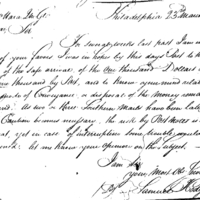
Arrival of money and inquiry on mode of conveyance
Asks for information on the safe arrival of money by post. Asks for opinion on the mode of conveyance, since southern mails have been lately robbed. -
No available image
No image available. -
Letter from Charles Weatherford to Creek Indian Agent James Seagrove on confusion since death of General McGillivray
Copy of Letter from Charles Weatherford to Indian Agent for the Creeks, James Seagrove. Weatherford reports that there is confusion and fighting between the Creeks and Chickasaws since the death of General McGillivray in February. Weatherford has sent headmen to the lower towns to stop the mischief. Reports that the Chickasaws have killed some Creeks and out of revenge, Creeks have killed Chickasaws. Problems will not be solved without difficulty; asks for approbation and timely response from Seagrove. -
The Mad Dog of the Tuckaubatchees' Talk.
PRINT - no source given in DE1 -
A talk delivered by Timothy Bernard to the Indians assembled at the Cussetahs and interpreted by himself
Timothy Bernard, Indian interpreter gives an address to Indians assembled at Cussetahs at Kinnards Cowpen. Bernard says he has lived many years in this land and took the job as interpreter to serve the county where he has resided most of his life. Warns against the bad talks that will be the ruin of the Creek Nation. These bad talks come from the white people and the Shawnee. Some of the whites use the Creeks to profit and then go live somewhere else. Cites the British during the Revolution as an example. Asks rhetorically, where are they now? Says that had it not been for McGillivray and Panton, the Creeks would be poor. Panton obtained liberty from King of Spain by paying ten thousand dollars per year to bring goods from their land. Remember these things and do not be short sighted. Beloved father General Washington is a friend. Warns against the dangers of listening to the Shawnee. Some of the whites ["of my own colour"] who do not look out for Creek interests. Will Cassks is one of them. Another is Caseman. Warns against whites who are encouraging Creeks to steal horses and then buy the stolen horses from the Creeks. Asks the assembled to be quiet until Major Seagrove arrives, who has been invested with the full power of General Washington, the great, good, and beloved father, who strives to do the best for his white and red children. Speech witnessed by James Holmes and George L Hull. -
Negotiations with Indians on Ohio River Boundary; Expectation of War
Wayne discusses the meeting he had with the Corn Planter and other chiefs and warriors and expresses his belief that the Indians have established the Ohio River as a firm boundary between the U.S. and Indian territory. Apparently there will be war unless a satisfactory treaty is negotiated. -
Orders to Proceed with Haste to Frontier
Surprised Winston had not yet arrived at Richmond, Knox ordered Winston to immediately repair to HQ of Gen. Wayne in Legionville, near Pittsburgh. -
Citizens of Glynn County make criminal allegations against Creek Indians
Collective statement given by citizens of Glynn County, Georgia that alleges various criminal conduct on the part of local Creek Indians. -
2,000 Head of Cattle Taken
"The settlers on this side of the river are not rich; notwithstanding the number of cattle taken already, as far as we can ascertain, is nearly two thousand head." -
Letter Citation
Cited in Knox to Seagrove, 04/30/1793; Knox to Seagrove, 06/10/1793; Seagrove to Knox, 04/19/1793. -
Instructions for the Sandusky Commissioners
The President orders his cabinet members and the Attormey General to meet and decide on the specific instructions to be given to the Commissioners who will attend the treaty at the lower Sandusky. They should also decide whether the credentials of the Quakers who wish to attend the treaty are such that they can contribute to a successful outcome.