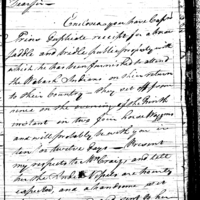
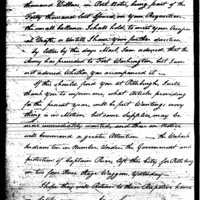
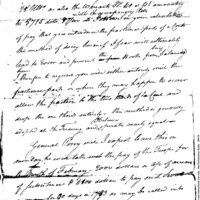
Bernard reports that he has met with Galphin and has sent for the Cussetah King. Most of the murderers and plunderers are concentrated near the Chatahootchee River; Chehaws and Usuchees still keep up the mischief. Towns below [Chatahootchee] are quiet. Cussetahs trying to keep peace. Cussetah King and Kinnard will send Galphin to Seagrove. They recommend sending horsemen above the Cowetas to burn, kill and destroy all they can find. The other towns will not oppose. This remedy could backfire and create a general war if a good commander does not discriminate between friend and foe. Cowetas passed a man shot in the head, ears cut off, and scalped; another man shot through hand. Kinnard thinks the sooner the Cowetas are routed, the better. Six killed at Rock Landing; four killed below Carr's Bluff. General Clark of militia has 2500 men ready to go after the nations. Bernard fears indiscriminate killing. Word has it that Spanish Officers coming through Chickasaws and Creeks. Panton will be there to give talks. Bernard wishes to oppose them, but laments that he has no commission. Most of the towns will not take up arms if they know they will be spared.
Blount reports on a possible Indian attack near Nashville and speculates on the possiblity that the Chickasws and Choctaws may join together in a war against the Creeks. It is not known whether the Cherokee chiefs will accept the invitation to travel to Philadelphia to meet with the President.
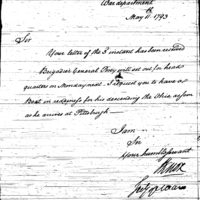
Brigadier General Posey will set out for headquarters next Monday. Requests that Craig have boat ready for descending Ohio River, as soon as Posey arrives at Pittsburgh.
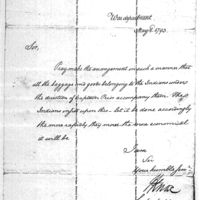
Hodgdon is directed to forward to Captain Nicholas Hannah of the 3rd Sub Legion at Alexandria in Virginia thirty complete suits of infantry clothing and five tents. There is a sloop lying near the Walnut Street wharf called the "Thomas & Sally" under the command of Capt. Mitchell that is bound for Alexandria.
Reports on fitting of boats at Legion Ville. Mentions Major McCully and taking charge of the boats at Wheeling. Directed Major Finley to give Denis Ferris charge of the boats and send them forward. Praises the work of the diminutive Ferris as a boatman and pilot.
Send $5000 in post notes, part of $40,000 in requisition. Asks for articles wanting, so as to prioritize the shipments. Wabash Indians under Captain Prior, left Philadelphia for Pittsburg in two four horse stage wagons.
Howell discusses a number of accounting concerns, including the rounding up of sums of two thirds of a cent and above, the pay of the troops for February, arrears of subsistence due officers for 1791 and 1792, and the absence of a need to include subordinate payrolls when the general payrolls have already been sent.
John Strong (?) testifies to the service of the now-deceased William McGraw during the Revolutionary War, being well-acquainted with him. Thinks he died in a Pennsylvania hospital.
Seagrove's deposition sworn before William Mowbray: " That, ever since receiving his appointment as Indian agent in the employ of the United States...he, the said agent, hath not been concerned, directly or indirectly, in any Indian trade or commerce by himself or with any person or persons whatsoever...and whilst he continues in the employ of the United States as Indian agent, he will not, directly or indirectly, be concerned in any Indian trade or commerce."
Wayne announces the safe arrival of the Legion at a place he has called "Hobson's Choice" near the village of Cincinnati. He bemoans the lack of stores and clothing for his troops and urges that they be sent immediately because of the precarious depth of the Ohio River. Despite the lack of adequate provisions, the state of military readiness is high though only in battle will the men be genuinely tested.
Blount discusses the measures he has taken to relieve the district of Mero as its inhabitants face the prospect of an invasion by the Creeks. The Cherokees appear to be disposed toward peace but still have not decided whether to accept the President's invitation to visit Philadelphia.
Notification of appointment to act as liaison to hostile Indians that reside north of the Ohio River. Treaty negotiations, names of other commissioners, and instructions for preparation.
Governor Telfair writes to Secretary Knox and calls for war against the tribes on the frontier. Telfair tells Knox to "let no idea of peace so far amuse as to divert the necessary and immediate preparations for war."