
Collection
Transcription Project
-
Request for White Wampum & Interpreters for Treaty at Sandusky Ohio
Six Nations interpreter Jasper Parish carries a letter from Federal commissioners for Treaty at Sandusky which attempts to enlist General Gibson's support as an Indian expert in obtaining white wampum and qualified interpreters for the Delaware and Shawanese languages. Major Craig at Pittsburg identified at the point of contact. Interpreters were supposed to travel with commissioners, but did not arrive in time for departure from Philadelphia. -
Report on preliminary proceedings of Federal Commissioners for Treaty at Sandusky
Document details the route of the commissioners to the treaty area. Pickering and Randolph traveled together. Lincoln came separately with stores and baggage. Pickering and Randolph route comprised Sunbury PA, Northumberland, Munsey, Licoming, Painted Post and Bath New York, Williamsburg, Genesee River, New York. Lincoln traveled from Philadelphia to Albany, Mohawk River and Oswego. Upon arrival 13 May, Canandaigua, Randolph and Pickering met Cornplanter, Farmer's Brother, Red Jacket and other chiefs of Seneca Nation. Commissioners told chiefs of plans to proceed to Sandusky Ohio and mentioned importance of these chiefs in bringing about peace. Chiefs not satisfied with answer of President of United States General George Washington to the chiefs relative to holding of treaty. Desire that British be invited, since they originally called the Indians to war against the United States. Governor Simcoe ordered Colonel Butler to attend the treaty; British seemed desirous of peace. Commissioners received wampum and a written speech. Chief had some papers and asked what they meant. Commissioners explained that these were speeches between General Wayne and Cornplanter. Commissioners entertained the Chiefs and received provisions for journey to Canadaigua where they are going to receive clothing from General Chapin. -
Craig discusses military stores and shipment with Hodgdon
Major Craig informs Samuel Hodgdon of the arrival of the Wabash Indians. Also, Craig states that no authorization has been received to release funds for Captain Prior. -
Deposition of James Seagrove, Creek Indian Agent regarding financial interest in Creek trade of commerce
Deposition of James Seagrove, Creek Indian Agent indicates that he had no direct or indirect financial interest in Creek trade or commerce -
Letter from Federal Commissioners Sandusky Treaty requesting interpreters and white wampum [money]
From Niagara, Commissioners have no information on whereabouts of William Wilson or James Rankin, interpreters for Delaware and Shawanese languages; and inquire on whereabouts of white wampum. They write to Major Craig at Pittsburg noting that it is of highest importance that they have their interpreters. Ask Craig to urge Wilson to come. If Rankin cannot come, find another competently skilled in Shawanese. Commissioners have sent Jasper Parrish, interpreter for Six Nations with this letter. Commissioners require $80,000 in white wampum for the treaty negotiations. Contingent draft from Secretary of War enclosed. -
Obtaining White Wampum
"Not having obtained any white wampum, either at New York or Albany, we have desired Major Craig to procure any quantity , not exceeding 80,000, at Pittsburgh; should he procure it, he will transmit you the account thereof, which we request you to pay at five days' sight hereof." -
Letter Citation
Cited in Habersham to Hodgdon, 05/28/1793. -
Clothing for Captain Jacob Slough's Recruits
Hodgdon should have forwarded to Lieutenant Robert Thompson at Lancaster for the recruits belonging to Captain Jacob Slough, twelve complete suits of infantry clothing. -
Questions About Certain Articles Provided by Stephen Bruce
Hamilton inquires about certain articles purchased from Stephen Bruce for the use of Captain Greaton and disallowed in the settlement of Greaton's account because they did not conform with the pertinent instructions. -
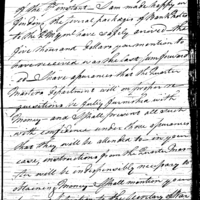
Bank notes; supplies; arrival of India Men
Expresses satisfaction in finding that several packages of bank notes arrived to the Quarter Master General. Will mention situation to Secretary of War in order to prevent any delay of supplies. Articles requested have been shipped or about to be. The India Men are arrived. -
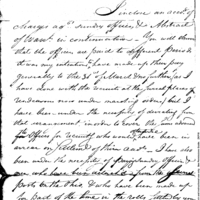
Covering the Sums Advanced to Officers for Recruiting, Etc.
It was Howell's intention to pay officers through March and no further as he had done with recruits at the various places of rendezvous, but he had to deviate from this arrangement to cover sums advanced to officers for recruiting. He has also had to pay officers detached from posts on the Ohio who have left prior to the arrival of their money. Paymasters should be informed of these matters. -
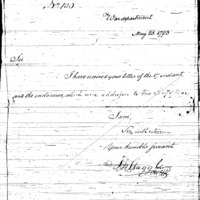
Receipt of Letters
Received letters and enclosures addressed to Secretary of War. -
Deposition on Spanish Complicity in Robbery & Murder at Traders Hill St Marys
George Galphin [presumably the son of wealthy trader of same name who died 1790] states that he was at house of John Kinnard at Hutcheta when James Burges, Indian trader, was accused by Kinnard of complicity in the murder and robbery at Traders Hill. Burges denied involvment and went on to state that some Indians had told him they had come from Pensacola, sent by the governor and William Panton, well known Indian trader, with directions to take hair [scalp] from Americans living on St Marys River. Indians were told not to return without committing American murders. Burges said these three Indians were the ones who killed Captain John Fleming and Daniel Moffett at Robert Seagrove's store. Burges stated he saw the Indians on their way back from St Mary's to Pensacola with stolen goods from Seagrove's store and scalps of the victims. Burges acknowledged that his brother in law was one of the perpetrators, but denied his son was involved. -
Craig discusses military stores and shipment with Hodgdon
Major Craig informs Samuel Hodgdon of problems maintaining sufficient funds to keep supply accounts open with the Quartermaster department. Craig indicates that he has contacted the Secretary at War on the same matter. -
Keeping the Peace following the Robbery and Murder at Traders Hill St Marys, the treachery of Spain in Florida, and punishment of mischievous Creek towns
Seagrove laments the deterioration of the peace on the Georgia frontier since the robbery and murder at Traders Hill. Says that majority of Creeks are peaceful, but their peaceful intentions have been frustrated by the bad men of a few towns. The peaceful chiefs, believing their is nothing more they can do, have asked the United States to send an army to destroy the Cowetas, Broken Arrow a part of Uchees, Usuchees, Big Tallassees and part of the Chehaws. Seven-eighths of the Creek Nation is friendly and will remain so unless the parties from Georgia go in. Seagrove dreads this scenario because there will be no discrimination between friend and foe. If the Georgians fall on the friendly towns, a general war may erupt. Seagrove notes that if only the aforementioned towns are struck, the business will shortly be over. Notes that punishing the offenders will be an effective means of deterrence against future mischief. Enemy numbers estimated at about 450. Recommends a body of 1000 cavalry under a cool, prudent commander as soon a possible. If delayed, flame may spread. Recommends that Knox send an experienced Major General from the Federal establishment to take command of an army against the Creeks. While there are capable militia Generals, Seagrove fears that the notion of discriminating friend from foe will be viewed as ridiculous and absurd. Fears this will result in a general Creek war, which will be undoubtedly bloody business and a ruinous expense to United States. This view is unpopular in Georgia, but Seagrove notes that he holds his opinions to be in best interests of nation. Seagrove has tried to secure as many allies as possible; friendly chiefs have asked for protection and have pledged neutrality. Spaniards continue to insult United States. George Galphin is right in his assertions and Seagrove believes the Old Tallassee King was employed by Spain to commit murder on the Oconee. Spaniards have established a post on the St Marys at New Hope, above Colerain and below Traders Hill. Colonel Howard [of the Spanish militia in Florida] visited and awaits arrival of troops from St. Augustine. He makes a profession of friendship to the United States. Seagrove has met with W. Payne, King and Head Chief of Simanola Indians, who arrived at Colerain with twenty of his people. Seagrove reports that he has convinced Payne not to join the disaffected towns. He sent Payne home well pleased; notes that Spaniards did much to prevent Payne from meeting him. Suggests that Colonel Howard may be mortified. Payne has said he will move down to Cape Florida until the troubles are over. Panton is trying to make peace between the Creeks and Chickasaws in order to destroy U.S. interests and bring on a general war. Seagrove believes that the seeds of the present troubles can be traced back to McGillivray and Panton and they are now coming to fruition. Sarcastically refers to Governor O'Neill of Pensacola as being rewarded for distressing the United States through the savages. Major White, who once came with [Spanish minister] Gardoque to Philadelphia is presently governor of Pensacola. Howard is full of intrigue. Governor Telfair continues to refuse to reply to Seagrove's letters. Mentions Brigadier General Gwinn of Georgia militia. Expect to hear from Major Butler. Seagrove returns to the Spaniards and their incessant intrigue. If there is a general war, Seagrove advises a decisive blow. To look for peace without doing this will prove abortive. Recommends John Sevier to lead this force, along with forces from South Carolina under Pickens to destroy all of the mentioned Creek Towns. Indians will be speedily conquered if attacked from different directions. Spaniards will know about all troop movements as long as there is open border between Florida and Georgia. Seagrove notes that he has kept the peace thus far, since the robbery and murders in March. -
Horrid Attempt to Kill Three Indians
Blount informs Knox of the attempt near his home of three armed men to kill three Indians. -
Letter Citation
Cited in Glenn to Hodgdon, 06/03/1793. -
Measures to prevent foreign aggression and protect neutrality
Describes measures to prevent foreign arms and aggression; discusses fitting and manning vessels as privateers; discusses neutrality of United States; mentions militia. -
Use of Militia Against Privateers
Letter, describes measures to prevent foreign arms and aggression; discusses fitting and manning vessels as privateers; discusses neutrality of United States; mentions militia. -
Letter from the Secretary at War to the Governor of Rhode Island
Letter, describes measures to prevent foreign arms and aggression; discusses fitting and manning vessels as privateers; discusses neutrality of United States; mentions militia. -
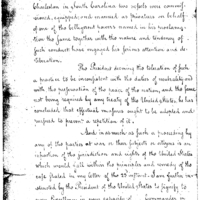
Measures to Prevent Foreign Aggression
Letter, describes measures to prevent foreign arms and aggression; discusses fitting and manning vessels as privateers; discusses neutrality of United States; mentions militia. -
Warrant to Pay Zebulon Pike
Order to pay Samuel Meredith with remaining balance from recruiting services. -
Letter Citation
Cited in Reasons for the Opinion of the Secretary of the Treasury and the Secretary at War Respecting the Brigantine Little Sarah, 07/08/1793 -
Appropriate Implementation of State Militias, Etc.
Letter, describes measures to prevent foreign arms and aggression; discusses fitting and manning vessels as privateers; discusses neutrality of United States; mentions the power of the governor to use his state militia if they deem it appropriate. -
Our Nation is Determined to be at Peace
The Cherokee chiefs offer assurances that, unlike the Creeks, they seek peace with the United States. They do not want to be blamed for any of the Creek depredations.