
Collection
Transcription Project
-
Payment for Transportation of Baggage to Pittsburg
Payment of $25.13 to Andrew Michaux for transporting baggage to Pittsburg. -
Letter Citation
Cited in Craig to Hodgdon, 07/99/1793. -
Account of Daniel De Benneville
Certification of pay and service for Daniel De Benneville, late Sergeant in the 13th Virginia Regiment. -
Secretary at War discusses status of stores with Major Craig
Knox directs the allocation of funds and supplies in support of current operations. -
Powder, Lead and Muskets to be Sent to Pittsburg
Request to send musket powder, lead and 750 new muskets to Pittsburg. -
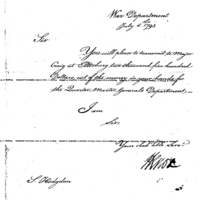
Request to Transmit Money to Major Craig at Pittsburg
Transmit to Major Craig at Pittsburg $2500 for the Quarter Master General's Department. -
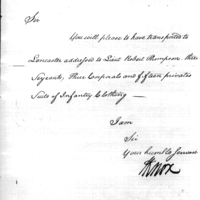
Infantry Clothing to Lancaster
"Will you please to have transported to Lancaster addressed to Lieut. Robert Thompson three Sergeants, three Corporals, and fifteen privates suits of infantry clothing." -
Letter Citation
Cited in Knox to Pratt, 07/06/1793. -
Council meeting in which the Commissioners of the United States, Colonel Simcoe, military officers and Indians from the council assembled
Commissioners report that on 29 June 1793, they embarked at Fort Erie for Sandusky, but winds not favorable and returned. On 30 June, winds still unfavorable; nevertheless commissioners embarked on Schooner Dunmore. On 5 July, Commissioners still detained by unfavorable winds. Vessel arrived from the Miami with Colonel Butler British Superintendent Indian Affairs, and Captain Brant, with fifty deputized Indians. Shawanese Chief Cat's Eyes addressed commissioners. He reports that he was sent by council at Miami to meet Federal Commissioners. They request presence of the father, the governor of the province. Asks not to be uneasy because of late arrival at Sandusky. Wampum exchanged and agreed to meet at Governor John Graves Simcoe's residence at Niagara on next day. Present at this meeting 7 July 1793 at Navy Hall, Niagara: Federal Commissioners, Colonel Simcoe, Governor General Upper Canada, civil and military officers, deputation of Indians, Captain Brant. Captain Brant, interpreter, explains that reason why Indian delegation was late was out of fear of white warriors on lands north of Ohio. Indians also want to know if the Commissioners have authority to make treaties and establish boundaries between United States and Indian Nations. Commissioners will provide answers following day; council fire extinguished. On following day, 8 July, commissioners express regret over presence of military force; assure Indians that President of United States General George Washington has forbidden hostilities during Sandusky proceedings; General Anthony Wayne has issued proclamation of same. Commissioners answer that they have been given authority to make treaties. Point out that concessions will have to take place on both sides if treaty to be successful. Ask for names of chiefs and nations represented. Speech was translated by James Dean in Oneida tongue, by Captain Brant's nephew in the Shawanese tongue, by another interpreter in Chippewa language. Cat's Eyes addressed commissioners by expressing thanks and acknowledge presence of English fathers. They take up pipes and retire to encampments. Will provide answer on next day. -
Letter Citation
Cited in Seagrove to Bernard, 07/29/1793. -
Letter Citation
Cited in Knox to Pratt, 07/06/1793. -
Letter Citation
Cited in Butler to Hodgdon, 07/16/1793. -
Account of Thomas Cheeke
Certification of pay and service for Thomas L. Cheeke, late Sergeant in the 14th Virginia Regiment. -
Events with Lower Creeks, Coweta, Broken Arrow, Usuchees and Chehaws
Letter to Seagrove, delivered by Mr Townsend. Reports on meeting held at Tuckabatchee. Upper Creeks agreed to cease hostilities on Georgia and give up property. Cowetas, Broken Arrow, Ussuchees, Chehaws have declined from what they agreed to at the meeting; will not give up property. General Twiggs, Georgia Militia gave talk to Cussetah. Bernard says Twiggs has for most part, been prudent in his dealings with Indians. Seagrove will receive a talk from big half breed or White Lieutenant of Oakfuskees, who has good intentions toward United States. Observes that during Alexander McGillivray's time, White Lieutenant swayed the best part of the upper Creeks. Panton continues to make trouble in undermining peace efforts. Has advised Indians not to give up any property, to insist on protection of John Galphin. Notes that when McGillivray died, Panton lost his tool. No prospects of understanding between Indians and whites as long as Panton continues to carry on trade and enjoys support of Spaniards. Governor O'Neal has left Pensacola, to be replace by Colonel White, who is less likely to tolerate the likes of Panton. Alexander Cornell, halfbreed, has done all he can, but has limited ability. Kinnard similar in this regard. Recommends settling matters without troops for fear of general war; militia generally not under good command of their officers. Fears influence of Spanish Dons in inciting Indians against United States, like the British did with the Shawanese. The troublesome towns could use a scourging. They look down and ridicule the Cussetahs for being slaves to Americans. -
He Hurt My Feelings!
The Quartermaster General is complaining that his requisitions for supplies of stores are not being attended to. Craig encloses a copy of the QMG's letter to the Secretary of War and laments that several expressions in the letter exceedingly hurt his feelings since he has not neglected to execute every part of his order with promptitude. -
Treaty Talks as Delaying Action; Desire for Offensive to Capture Supplies
Wayne continues to believe that the treaty talks are simply the means by which the Indians and British seek to procrastinate until the military situation is most favorable to their interests. He believes that his Army is ready for the campaign but continues to lament the lack of supplies. He argues that a campaign against the location of Indian stores should be taken immediately so as to capture them for American use. -
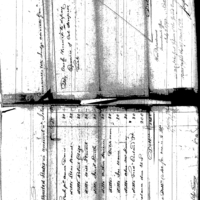
Account of John Laurence, Judge Advocate General
Statement of the account of John Laurence, Judge Advocate General; by Joseph Howell in the War Accountant's Office, to the Auditor of the Treasury. -
Account of John Laurence, Judge Advocate General
Account of John Laurence, Judge Advocate General; from Joseph Howell at the Accountant's Office to the Auditor of the Treasury. -

Account of the 4th New York Regiment
Certification of service and pay for John (?), late of the 4th New York Regiment. -
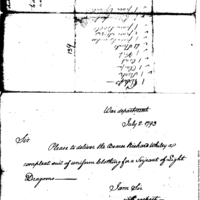
Sergeant's Clothing
Hodgdon is directed to deliver to the bearer Richard Whiley a complete suit of uniform clothing for a sergeant of light dragoons. -
Pay warrant and receipt for salaries of the War Office
Account of War Office salaries. Includes John Stagg, Constant Freeman, Benjamin Bankson, Philip Audebert, Nathan Jones, James Henry Langier, David Henly, Jacob Hoffman, and Frederick Sprigg. -
Swords Requested
The Secretary of War requests Hodgdon to send one of the swords made the previous year and also one that Mr. Francis has just turned into the store. -
Appointing a Confidential Agent of the Quartermaster's Department
Craig must appoint a confidential agent of the quartermaster department if one does not already exist and balance [Lieutenant Colonel] Sprout in Marietta. -
Letter Citation
Cited in Knox to Seagrove, 09/16/1793. -
Confrontation with Indians at Spanish Creek
Captain Randolph reports from Colerain Station, west of St. Marys Georgia, that Mr McDonald saw some Indians on the path. Randolph responded by sending out men. They fell in with Indians at Spanish Creek. A confrontation ensued and four Indians killed; no whites lost. Got excellent horses as a result. Alexander Young and Mr Wright want to take possession of Bullhead blockhouse; need more men and ammunition. [Indians turned out to be friendly; David Cornell was one of those killed].