
Collection
Transcription Project
-
We shall sail with the first fair wind.
Commissioners LIncoln, Randolph, and Pickering report on the status of their expedition to treat with the Western Indians. -
Articles for the Southward
Mr. Francis being out of town, Govett asks Hodgdon to inform him of the articles that have been ordered for the southward and he will endeavor to have them ready. The orders from the Treasury don't mention the quarter the articles are intended for. -
Letter Citation
Cited in Knox to Wayne, 08/16/1793. -
Letter Citation
Cited in Knox to Wayne, 08/16/1793. -
Letter from John Pratt
Text copy is poor. -
Cabinet Meeting: Opinion on the Case of the "Little Sarah"
The British brigantine "Little Sarah" has been captured by the French and brought to Philadelphia to be fitted out as a privateer. Hamilton and Knox believe she should not be allowed to leave port until a decision has been made by the President as to her disposition. Jefferson dissents. -
Response of Commissioners and Captain Brandt to Indian Speech of 07/07/1793
Regrets to hear reports of war, only peace intended by United States. Commissioners have authority from their government to negotiate. -
Indians' Speech
Requested reasons for "warlike appearances" of the United States. Commissioners to answer the following day. -
Answer of Federal Commissioners for Conference at Sandusky to speech delivered by Captain Brant on behalf of western Indians
Delivered by interpreter Captain Brant on behalf of Western Nations, Commissioners restate questions and issues presented by Western Indians previous day. Commissioners express regret at warlike appearances of United States north of Ohio [presumably Major General Anthony Wayne's forces.] Commissioners state that they do in fact have authority to make treaties based on the appointment by President of United States General George Washington. Ask that Indians understand that President seeks peace and has no designs to send warriors against Indians during this conference. Commissioners state that Great Chief General George Washington forbids hostilities during Sandusky talks. They hand over a proclamation of peace by Major General Anthony Wayne which forbids governors of Virginia and Pennsylvania from hostile actions against Indians. Commissioners state that they have authority from government to make decisions on a new boundary line between United States and Indians. They ask for the names of the chiefs and the nations they represent. They pledge to send a messenger to Great Chief of United States General George Washington tor repeat his orders forbidding hostilities during the conference. Exchange of wampum and closing remarks. Chiefs will provide answers next day 9 July 1793. -
Letter Citation
Cited in O'Hara to Knox, 08/08/1793. -
Murder of Indians and David Cornell, son of Joseph Cornell, the mutinous withdrawal of Georgia militia, and his affidavit regarding financial interest in Indian trade or commerce
Seagrove reports the circumstances surrounding the confrontation and murder of friendly Indians vicinity of Colerain Station and Spanish Creek on St Marys. Reports on McDonald's inconsistent account of events to his commanding officer. Reports on death of David Cornell, son of Joseph Cornell who acted as interpreter with General McGillivray' entourage during treaty negotiations at New York 1790. McDonald is in custody. Seagrove expects some limited bloodshed; has taken measures to emphasize the incident was a mistake. Sarcastically refers to mighty expedition of Georgia militia as abortive and ill planned, as a mutinous spirit took possession of officers and men when they reached the Oakmulgee. Seagrove notes that he has tried to portray this incident in a light favorable to interests of United States [presumably through his dispatches informing Indians that General George Washington ordered withdrawal of Georgia militia]. Seagrove refers to insinuation that he had financial interest in brother Roberts trade at Traders Hill on St Marys. Sends affidavit to Knox, dated 9 May 1793, in order to satisfy Knox on this matter. Refers to the malicious attacks of the anti-federalists and Yazoo gang of Georgia. If these men ever spoke well of Seagrove, it would be evidence of his infidelity to the federal government. -
Notice of Accounts Settled and Stores Forwarded
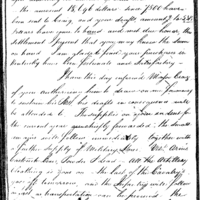
Informs James O'Hara that he has received a warrant for the remaining amount drawn on him. Major Craig is informed of his authorization to draw on him to sustain his post. The supplies for the current year have been forwarded. The cavalry is departing tomorrow, and the infantry will follow when transportation becomes available. -
Account of Will Coulter
Certification of pay and service for Will Coulter, late Corporal in the 1st Regiment of Light Dragoons. Coulter is owed 485 dollars -
Letter Citation
Cited in Swan to Howell, 08/04/1793. -
Letter from the Secretary of War
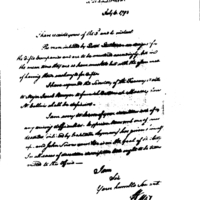
The men intended for a rifle company are to be mustered accordingly. Mentions the Secretary of the Treasury. -
Recruits for Post at Wheeling
Reiterated orders from previous letter (28th ultimo) to proceed with construction of post at Wheeling, updates on number of recruits to staff post en route from Pittsburgh. -
Commissioner's Notes on Treaty Proceedings
Before arrival of commissioners at the council house from Navy Hall, while waiting for them, Captain Brandt spoke. He noted that it was agreed at the Rapids [of Miami River] that Indians should come and meet the commissioners in their father's presence, presumably John Graves Simcoe. Thanks to Great Spirit for making meeting possible. Mentions an inclination to do what is right and just. Makes mention of wampum. -
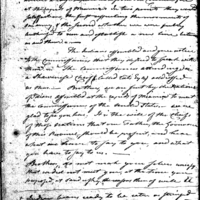
Indian Speech to Commissioners
Indians apologized and provided reasoning for not meeting commissioners at Sandusky, requested to meet with "Governor of this Province" (John Graves Simcoe) at Niagara for negotiations. -
Seagrove's Indian Houseguests and Washington's Orders for Georgia Militia to Temporarily Halt Operations against Bad Towns
In letter to Kinnard, Creek intermediary, Seagrove acknowledges receipt of talk by George Galphin. Refers to Chehaw fellow living at Seagrove's house as a fool. Notes that he should have sent the guests, including the Cussetahs, away some time ago, but he was afraid they might be killed by whites. Georgia militia troops in upper part of Georgia that crossed Oconee were called back by order of great father General George Washington. Reassures Kinnard that he and his friends will not be hurt. -
Killing of Creek Indians at Spanish Creek & Detention of Indians at Seagrove's Home
Seagrove recounts the incident whereby Creek Indians were reportedly mistakenly killed by whites at Spanish Creek. Points out that David Cornell was killed by same man whose brother Cornell killed past winter on frontier of Cumberland. Expresses hope that matter can still be settled peacefully. Seagrove then reports on detention of Indians at his house, including the incident whereby one Indian killed himself. Relates that President of United States General George Washington has ordered Governor of Georgia to act only on defensive for time being. -
Letter Citation
Cited in Thomas to Seagrove, 07/19/1793. -
Whereabouts of Men and Boys from Cussetah Town
Seagrove reports that men and boys are staying at his house for their protection. They are well fed and being taken care of so well, they do not wish to leave. Reports that Indian cut his throat. Seagrove refers to enclosed letters for Alexander Cornell, Cussetah King and Kinnard. Chaves, the bearer can provide details. Reports that Great Father General Washington has forbid any troops from going into Creek towns until matter is settled. Troops ordered to cross Oconee to punish bad towns have been ordered back. -
The Indians Killed at Spanish Creek
Seagrove reports that white Scouts and Indians mistakenly fell in with one another, resulting in death of four Indians, including interpreter David Cornell, cousin of Alexander Cornell. Seagrove laments the deaths of friends caused by friends. Blames McDonald, who Seagrove is holding as a prisoner. Seagrove assures Cornell that full satisfaction will be made under terms of Treaty of New York. He asks that Alexander Cornell, Mad Dog, White Lieutenant and Joseph Cornell [David Cornell's father] not alter their good opinion of the whites based on this accident. As proof of good intentions, Seagrove notes that he has eight Indians living at his house. Reports that great father, President of United States General George Washington has forbidden governor of Georgia from going into the Creek land until situation resolved. Seagrove asks for the same restraint that his people exercised following the robbery and murder of Captain Fleming at Traders Hill St Marys. That Cornell tell his uncle that Seagrove has always been a better friend than General McGillivray. -
Craig discusses military stores and shipment with Hodgdon
Major Craig acknowledges the receipt of a ration of clothing but laments not getting a resupply of cash from Hodgdon. -
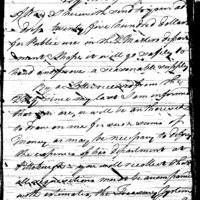
Delivery of Money, Clothing, Arms, Powder, and Lead
Sends $2500 for public use in Quarter Master's Department. Provides guidance for drawing future sums. Reports on delivery of clothing, arms, powder, lead.