Butler acknowledges that he has received the clothing and arms and gave his receipt to the wagoner. However, he finds himself perplexed in providing knapsacks since Hodgdon did not send any.
"I have the honor to submit to you the letters brought by the express from the Southwestern Territory relatively to the barbarous murder committed by the Whites on some friendly Cherokees."
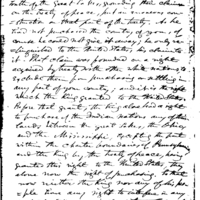
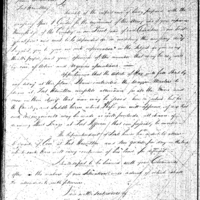
Ownership of land near Great Lakes is erroneous. United States gained the right to claim land through the grant of the King of England, but the Indian Nations decided to revoke that right to claim.
Major Gaither informs Knox of possible hostilities by Indians against white families [30 dead] vicinity of upper part of Georgia, not far from Ft Matthews. Source of information militia General Twiggs. Gaither questions veracity. Reports that citizens fully behind the militia; has heard that militia plans to cross into Creek nation about the mouth of Shoulderbone.
Major Craig forwards the following reports to Secretary Knox: a return of stores, an abstract of accounts, and all vouchers of disbursements. Craig indicates that a contractor successfully sued for his pay in Allegheny County Court.
Wayne has been informed by Mr. Morrison, a gentleman of veracity, that he saw between twenty and thirty wagon-loads of public stores laying at Shippensburg. Mr. Martin who brought them that far was so infamous a character that he would not hire a team to bring them on to Pittsburgh. He has uniformly defrauded every person with whom he has had any dealings. Wayne fears that if the water fails as it did the previous year his army will be the ultimate sufferers.
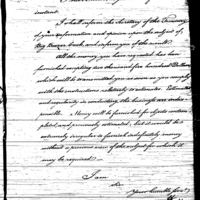
Will inform Sec of Treasury of opinion regarding Big Beaver Creek. Result will be transmitted. Money will be transmitted once Craig follows instructions and forwards estimates.
Jefferson, Hamilton, and Knox provide their opinion respecting the disposition of sundry foreign vessels arming and arriving in American ports. The President has declared that each case should be decided strictly according to the law and comforming with treaties negotiated by the United States and will therefore refer these cases to persons knowledgeable in the said laws.
Swan encloses to Howell his Warrants No. 46 - 72 with payrolls and muster rolls complete, with receipts, amounting to $21.960.46. Swan asks for Howell's acknowledgement of same as soon as it is convenient.
Refers to guide for the movement of the army and Wilkinson's superior knowledge of the local area. Worries that articles will fall short. Has instructed wagon masters at Fort Hamilton how to care for horses and oxen in their charge. Seeks approval for saddle horses. Discusses sending pack horses to Fort Hamilton with corn.
Commissioners Lincoln, Randolph, and Pickering stress to the President that General Wayne should remain quietly at his posts until the outcome of the negotiations with the Western Indians are fully known.
[Partly illegible] Harris assures Hodgdon that nothing material has transpired since his last letter. He asks that the enclosed be forwarded as it was damaged coming through the Missouri.
Lincoln recapped events of council fire with hostile Indians at the rapids of the Miami River, advised against any military activities during treaty negotiations. Suspects Gen. Wayne of violating truce.
The Commissioners are warning Knox that Wayne's recent movements and provisioning send a strong signal to the Indians at the Niagara peace council that US forces are preparing for war.
In this letter the Federal Commissioners for Sandusky Conference request that President Washington issue fresh orders to Major General Anthony Wayned to abstain from hostilites and to remain quietly at posts.
Commissioners comment that deputation of Western Indians a fortunate event. Discuss the request for fresh orders from President of United States for General Wayne troops to remain quiet at post. Captain Brant has information that Wayne's troops have cut fresh roads from Ft Washington to Indian country in a direction that would miss Ft Jefferson. Evidence of stockpiling of provisions that appear to be preparations for war. Commissioners concerned that negotiations will be delayed if Wayne's troops call the Indians from the council. Wayne's activities viewed as unfair by British.
Council convened on 9 July 1793 at Navy Hall Niagara. Captain Brant, interpreter furnished opening remarks of good will and conducted ceremony with strings and belts. Chiefs state that the Western Indians are of one mind, and if they can agree with whites, peace may ensue. Prior treaties were not binding because they did not account for all the tribes as one. Chief then provide the nations in attendance, listed as follows
Five Nations, Wyandots, Shawanese, Ottawas, Chippewas, Potawanamees, Cherokees, Miamis, Mingos.
Commissioners replied; seek a termination of war on terms agreeable to all parties.