
Collection
Transcription Project
-
Expenses to Fort Washington
Hodgdon is asked to advance the bearer, Jacob Hellerman [?], enough money to cover his expenses to Fort Washington. Since General Knox is out of town, a warrant cannot be procured. -
Regarding Captain Samuel Nicholson request to draw rations at Boston
Pickering denies Captain Nicholson's request to draw rations on the grounds that there is no commissary to supply one officer and none of the other officers draw rations at present. -
Letters, Stores Forwarded, Request for a Cask of Sherry Wine
Received sundry letters. Barrel of sugar for Colonel Sergeant will go forward. Mentions providing gears for the trumbels. Is sending forward stores and clothing. Asks for a cask of sherry wine that he would wish a friend to drink a little of. -
Governor of Georgia writes to Secretary at War regarding Indian hostilities
Governor Telfair forwards evidence supporting the case for war against the Creeks to Secretary Knox. -
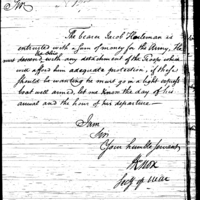
Protection for Bearer of Money
Requests protection for Jacob H[a]deman who was entrusted with transporting money down the Ohio River for army. -
Capture of the Brig "Nancy"
Jefferson is asked to inform the British minister that two French privateers have captured the brig "Nancy" of Jamaica and taken her to New London. The Governor of Connecticut has captured this brig with a party of militia and will deliver her up to her master or owner but so far no such persons have appeared. -
Foreign Politics and Privateers
Policy regarding British privateers and seized French goods discusssed. -
Extract of a letter from General Twiggs to Governor Telfair
General Twiggs describes Indian crimes in Green County to Governor Telfair. -
Request from Major Gaither to Governor Telfair to raise troops under Gaither's command for defense of Georgia
From Augusta Georgia, Major Henry Gaither expresses opinion that number of Georgia militia in service is excessive for defense of Georgia frontier. Proposes addition of 100 cavalry and 100 infantry to Federal Troops, to be placed under his command which, Gaither believes, if properly deployed, would be sufficient to guard and protect inhabitants. Notes that the above addition was ordered by President of United States General George Washington, to be raised by Telfair and put under Gaither's command. Asks for a response within 24 hours as promised by Governor. -
A report of a council of federal officers requesting party of federal troops to provide security for James Seagrove and his party during peace visit to Creeks
Federal Officers request [recipient unknown, perhaps Major Gaither] that protection be given to James Seagrove. Base this recommendation on James Aiken's deposition which describes threats from Georgia citizens against Indian Agent Peace overtures. Officers identify a party of militia stationed at Rock Landing headed by Jeremiah Oats which may run into Seagrove's party. Recommended security force consisting of Sergeant, Corporal and 12 Privates under Captain Dickinson -
Courier to carry cash to Pittsburgh
Asks for a reliable courier to carry cash to Pittsburgh. -
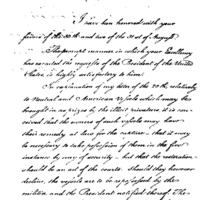
Further Explanation of Federal Policy on the Return of Ships Captured by Illicit French Privateers; Regarding Funds for Connecticut Militia
Knox further explains the president's decision that American shipowners seeking to have remanded to them ships captured by the "illicit" French privateers [those outfitted in American ports, to the violation of American neutrality] do so in the courts. He also explains that preparations for the payment of the expenses of the Connecticut militia are underway. -
James Seagrove Creek Indian Agent to Secretary of War Henry Knox on meeting with Georgia Governor Telfair
Writing from Augusta Georgia, Seagrove informs Knox that after meeting Georgia Governor Telfair, he has written a follow-on letter in order to inform the Governor of his movements to meet the Creeks on 10 September 1793. Seagrove will remain in Augusta for the day in case the Governor needs to speak with him. -
James Seagrove Creek Indian Agent letter to Georgia Governor Telfair on planned meeting with Creeks on 10 September 1793
From Augusta Seagrove recounts his meeting with the Governor on 5 September 1793 and informs Governor of Georgia Telfair of his plans to meet with the Creeks. He informs Telfair that his mission is in conformity with orders of the President of United States General George Washington and Secretary of War Henry Knox. Seagrove assures the Governor that he will communicate fully on all matters in his efforts to restore the peace. Seagrove departs for Rock Landing on Oconee next day. Seagrove asks the Governor to inform him of any military operations against the Creeks in order to provide for his personal safety and for those traveling with him. -
Deposition of Henry Carrel take by Jared Irwin
Jared Irwin takes the deposition of Henry Carrel. Carrel gives report of Indian crimes. -
Major Craig sends status report from Fort Pitt to the Secretary at War
Major Craig informs Secretary Knox on the following items: due to increase in boatmen transportation costs will rise; he has letters for General Wayne; due to Yellow Fever in Philadelphia he will handle clothing shipped from that point with appropriate caution. -
Governor of Georgia writes to Secretary at War regarding Indian hostilities
Governor Telfair tells Secretary Knox that the establishment of a paper peace with the Creeks can be of no duration. -
A report from James Seagrove Creek Indian Agent on meeting with Georgia Governor Telfair regarding Georgia Militia planned offensive operations against the unfriendly Creek Towns
Seagrove reports that he and Captain Constant Freeman met with Georgia Governor Telfair on 5 September 1793 to discuss matters regarding the Creek Nation and Georgia inhabitants. Seagrove informed Telfair about his plans to visit Creeks on 10 September. Telfair informed Seagrove that an expedition was determined to go on against unfriendly Creek Towns; that this was what the people of Georgia wanted, and it would be impossible to restrain them. Telfair contracted for rations to feed approximately 4000 men. No information on the time of calling these men into service or their term. Telfair thought Seagrove's efforts to meet with the Creeks altogether useless; the Indians needed to be chastised before any peace discussions could take place. Seagrove warned of the possibility of a general Indian war; pointed out that Governor was acting contrary to wishes of Federal Government and the President of United States General George Washington. Closes by noting that John Galphin [implicated in robbery and murder at Traders Hill] has been take in by Panton. Panton, Seagrove notes, continues to be a menace against United States. Reports that General Andrew Pickens [veteran Indian Commissioner] has returned home [presumably from Philadelphia where he met with General Washington to discuss a proposed expedition against the southern Indians]. -
Letter Citation
Cited in Freeman to Simmons, 02/13/1799. -
Letter for Secretary of War Henry Knox to South Carolina Governor William Moultrie requesting that he refrain from providing military assistance to Georgia militia in proposed offensive operations against Creek Nation
Knox refers to the proceedings of the Council of War of the General Officers of Georgia Militia. Knox attempts to clarify his guidance, which seems to have been misconstrued as sanctioning South Carolina support for the Georgia militia plans to undertake offensive operations against the Creek Nation. Knox requests Moultrie to refrain from providing military assistance to Georgia. -
Regarding offensive expedition against certain Creek Towns, the legal authority to declare war, the requirement for a formal declaration of war, the effect of European politics, Spain and the Court of Madrid, outrages against Cherokees and the authority of states to come to the aid of one another
From the Secretary of War to Georgia Governor Edward Telfair. Planned offensive expeditions against the Creeks by Georgia militia are a matter of concern for the President of the United States General George Washington. Knox conveys the President's disapproval of Governor Telfair's measures. Knox notes that such an offensive expedition is not authorized by law, and making provisions for its support belongs to congress. He points out that no declaration of war has been made against the Creeks; until such is done, all offensive operations will be unlawful, and expenses cannot be paid by the Federal Government. Knox further points out the delicate nature of European affairs, and other southern Indian tribes. Because of negotiations with the Court of Madrid, an invasion of the Creeks may drive Spain to request assistance [presumably from Britain]. Knox points out that it seemed that hostilities were subsiding, but in June whites committed outrages against the Cherokees, which will require satisfaction. Expresses concern about the possibility of a confederacy of Southern tribes against the United States. Knox addresses the August 1793 failure of the Sandusky conference with the Western Indians. President deems the offensive expedition as unauthorized by law, and contrary to his instructions and intent conveyed by Knox to the governor in previous correspondence. Knox sharply questions whether South Carolina's military aid to Georgia is in keeping with President Washington's guidance and intent. -
Accounts of Joseph Ellicott
Lists accounts kept by Joseph Ellicott, surveyor. -
Letter Citation
Cited in Knox to Huntington, 09/14/1793. -
Letter Citation
Cited in Freeman to Simmons, 02/13/1799. -
Letter from Constant Freeman to Henry Knox on arms and ammunition for Georgia militia, James Seagrove's 10 September meeting with Creeks, on disagreement between Seagrove and Governor Telfair on whether there is peace with Indians in Georgia, Federal supply of militia troops, the cross-purposes effect of Georgia's war mobilization on Seagrove's meeting with Creeks,
From Augusta, Freeman, agent to Department of War in Georgia reports that arms and ammunition intended for Georgia will arrive in about 10 days. Discusses matter of paying militia and future musters of militia. Reports that there are about 600 militia in service. Seagrove reports that there have been no Indian depredations, but this assessment is at odds with Governor Telfair's. Both Georgia and South Carolina militia mobilizing. Discusses the issue of contracts and points out that there are only contracts for for supplying the troops of Georgia. Seagrove points out that his efforts to talk with the Creek leadership on 10 September 1793 is at cross purposes with the efforts of the governors of Georgia and South Carolina.