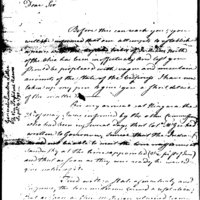
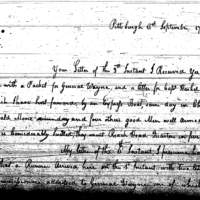
Wayne wonders about the validity of the intelligence received from sources that he deems questionable but promises that his Army will be ready when needed. He forwards a list of officers due for promotion as well as information regarding Courts Martial and questions one Court Martial initiated by Gen. St. Clair.
Suits of clothing ordered Lieutenant Whistler are to be included in those Knox ordered. Has requested Secretary of Treasury to order tents. No buckles.
Mentges sends the following reports to Secretary Knox: the return on public property on hand with the commissary of military stores department in the district of Maryland and Delaware under the direction of Donaldson, the report on cannons at Elkton, and the report or ordinance stores at Turner's Creek.
Hodgdon is directed to have carefully packed up and sent to Spring Garden, that evening or the next day, articles of clothing and camp equipage for the use of Capt. Cornelius R. Sedam's Company.
From the War Department, Knox informs James Seagrove Creek Indian Agent, that his recent correspondence has been received and forwarded to President of United States General George Washington. Knox applauds Seagroves efforts at trying to bring about peace. Knox notes that if Seagrove's efforts are fruitful, then he will be doing a great service to his country which will be highly acceptable to President Washington. Knox asks Seagrove to extend an invitation to about a dozen chiefs of the upper and lower Creeks to visit with President Washington during the upcoming winter. Recommends that he avoid the old faces of the Treaty of New York in 1790 and instead bring in the likes of White Lieutenant and Mad Dog.
Knox informs Seagrove that he has written to Governor Telfair expressing his and President Washington's displeasure over efforts to conduct offensive operations against the Creeks.
Thomas Jefferson with compliments to Mr. Sterrett will thank him for giving a safe conveyance to inland, which he prefers making from Baltimore. Mentions bill of exchange, Van Shepherd and Hubard.
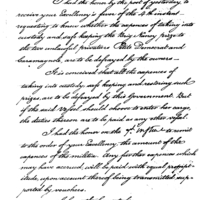
Responds to a request for procedure regarding the return of a captured Brig, Nancy, to her owners, after being confiscated by two illicit privateers, Petite Democrat and Caramagnole. Knox says that the cost of seizing and returning the ship will be paid by the federal government, rather than her owners, though if the ship's cargo is to be sold in its current port it still must pay the usual duties. Also confirms that all present and future Connecticut militia expenses will be paid by the federal government.
Major Craig updates the Secretary at War on the following matters: his handling of General Wayne's correspondance; problems of contracting for beef; clothing shipments; Colonel Clark's escorts for supplies shipped via boat.
Writing from Augusta, Freeman has met with Georgia Governor Telfair; expects to see appointment of paymaster for militia, along with orders for mustering. Has not been able to obtain a listing of the numbers of troops employed. Governor believes forces should remain at current levels. Notes that in response to Knox's letter ordering a stop to offensive operations by Georgia militia, Governor Telfair has responded accordingly. Major Habersham in communication with Secretary of Treasury regarding contracts. On 7 September 1793 James Seagrove proceeded to Fort Fidius on his way to Oakmulgee, with Major Gaither and Mr. Whitney. Points out that Governor Telfair does not think Seagrove's efforts will bear results. While many Georgians support offensive operations against the Creeks, there are some who are concerned about the consequences should the expedition fail. Reports trouble with Indians: stealing of horses from Long Bluff, Washington County and Mr. Cribbs and Mr. Hill in Green County. Skirmish at Long Bluff resulted in Indian party killed.
Knox argues that the Swedish neutral vessel brought into U.S. ports before August 5th is not included in the rule to restore vessels taken by privateers after that period. The appeal to the Circut Court should be prosecuted and if the ruling is unfavorable, then it might be proper to interfere by force if the President so declares.