
Collection
Transcription Project
-
Lyman writes to Knox about recruiting
Letter, encloses weekly return of recruits; asks for balance due on accounts. -
Letter Citation
Cited in Hodgdon to O'Hara, 11/14/1793. -
Discusses Accounts between War and Treasury Departments and Garrison Supplies
Explains accounts between the Treasury Department and the War Department. Refers to terms of treaty. Discusses stores for garrisons. Reports activities of troops seeking to change garrisons. -
Craig discusses military stores and shipment with Hodgdon
Craig expresses pleasure to hear Hodgdon is recovering from the fever that plagued Philadelphia. Clothing sent from Philadelphia was repackaged at Fort Pitt due to concerns regardinging the spread of infection. Craig thinks the practice of repackaging is now unnecessary. Craig requests nails and stationary from Hodgdon. -
Audibert discusses administrative matters with Knox
Letter, advises Knox re War Office. -
Frontiers are Infested with Indians
Smith reports on the sufferings of the inhabitants of the southwestern frontier. He notes that the Chickasaw head-man Mountain Leader intends to visit the President. The Cherokees are committing frequent depredations including the slaughter of an entire family of thirteen. The Indians are so bold as to be reconnoitering General Sevier's movements and his camp. -
Letter from W Urquhart on behalf of Georgia Governor Telfair to James Seagrove on conditions for peace with Creek Indians
From the Georgia Statehouse in Augusta, Urquhart relays Governor of Georgia Telfair's requirements on the part of the state of Georgia for peace with the Creek Indians. Captured property and contracts restored; prisoners returned; perpetrators of murders (13) be surrendered; requires 10 headmen of the lower Creek Towns as hostages until requirements fulfilled. State of Georgia will not recognize peace without commissioners at the treaty. -
LtCol Melton informs the Governor of his actions
LtCol Melton informs the Governor of his raids against the Creeks and he requests to move the prisoners to a location where local sentiments do not pose a physical threat to the captives. -
Statement of Frederick Dalcho Surgeons Mate Legion of United States on Georgia Militia efforts to intercept James Seagrove during peace overtures with Creeks
Statement by Frederick Dalcho Surgeons Mate given on 25 September 1793, attested by James Seagrove. Dalcho reports that some Georgia militia were pursuing some Indians in order to recover stolen horses. During this pursuit, they were ambushed by Indians. As a result, party headed out led by Colonel Alexander, Colonel Melton, Colonel Lemar, Major Fauche, Major Adams and other officers and men. Intent was to ambush Indians and intercept those who wished to treat with James Seagrove Creek Indian Agent. Adams expressed a wish that Seagrove and Barnard be killed for pacifying the Indians and for paying them to destroy the frontier inhabitants. Called United States Congress a set of rascals and Secretary of War an enemy of Georgia. If he could, he would drown them all. Believed that the Executive Officers of Federal Government wished to see state of Georgia destroyed by Indians. Federal troops are of no use in protecting frontier. Adams reiterated that Indians trying to treat would be killed. Apparently Colonel Melton gave authority to do so. Statement substantiated by Mr Armour of Greensborough. -
The Flame Will Break Out
Freeman comments on the turmoil on the southwestern frontier, noting that nothing in Knox's letter permits the Governor to authorize a war agains the Creeks. He fears that if Seagrove meets with the Creeks, they will kill him. Becaise of the depredations of the Creeks against whites, restraining the settlers from seeking revenge is difficult and war could break out at any time. -
Letter from Captain Constant Freeman to Secretary of War Henry Knox on conflict between state of Georgia intentions with Creek Nation and those of Federal Government
Freeman notes the great contradiction between the designs of the Governor of Georgia Telfair and the militia, and the designs of the Federal Government with regard to military strategy against the Creek Nation. Freeman laments that, knowing that offensive operations against the Creeks are not part of the federal strategy, he wonders if he should interfere with Telfair's offensive designs against the Creeks. Reports that because of Seagrove's attempts to go into Indian country, Georgia militia threaten his life. Freeman does not believe that Seagrove can achieve peace because the people of Georgia are in favor of war with the Creeks. There are repeated depredations by Indians, fueled partly by whites within the Creek Nation. Militia has not been reduced; Freeman can not obtain a return from Governor Telfair, despite repeated requests. Governor likely does not intend to raise the hundred cavalry and hundred infantry. -
Letter Citation
Cited in Blount to Knox, 10/12/1793. -
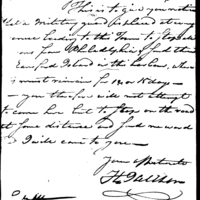
Jackson informs Knox that road to Boston has been blocked
Letter, Jackson advises Knox of road block & quarantine. -
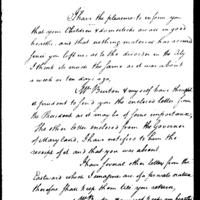
Audibert discusses administrative matters with Knox
Letter, Audibert advises Knox regarding War Office business. -
Letter Citation
Cited in Audebert to Knox, 09/27/1793. -
Death or Glory, Etc.
The army moves within two days for God knows where toward the Miami in high spirits. Whether for death of glory will be known in two months. Shaylor asks Hodgdon to forward in a safe way his letter, which contains some money, to the gentleman to whom the enclosed is directed. -
Report from Major Henry Gaither to Henry Knox Secretary of War on Georgia Militia efforts to intercept James Seagrove Creek Indian Agent
While riding with James Seagrove, received information of efforts to disrupt Seagrove's attempt to meet with Creek Nation. Reports that both Colonel Alexander with about 100 men, and Captain Charles Williamson, with his troop, attemted to cross the Oconee to intercept Seagrove. Intent is to intercept dispatches and attack friendly Indians. Gaither notes that these are same militia who expect to be paid by United States. Says he will not muster militia unless he verifies that they have been called by proper authority of United States. Praises Captain Freemand and Mr Whitney for their assistance. Gaither notes that he has requested that Georgia Governor Telfair call out 100 infantry and 100 cavalry to be placed under Gaither's command. -
Letter from James Seagrove Creek Indian Agent to Governor Telfair on Creek wishes for peace and request that Governor stop Georgia Militia disruptions of peace efforts
Reporting from Fort Fidius on the Oconee, Seagrove says he is receiving expressions of friendship from the Creeks. Peace with the Creeks on terms of equal justice is the policy of the Federal Government and hopefully it is the wish of the people of Georgia. Seagrove says he will leave for the Creek Towns the next day 23 September 1793. Asks that Telfair put a stop to militia interfering with his peace efforts. Questions whether Telfair knows about the militia parties disrupting his efforts and is doing nothing to stop it. Suggests that Georgia's current policies regarding Indians could bring on a general Indian war for the United States. Suggests that the governor use his power to prevent this from happening. Spaniards are agents are behaving favorably. Cherokees calling on Creeks for general war. Creeks refused. Northwest frontier of Georgia in danger. Recommends people be alert. Spaniards -
LtCol Melton's statement to the Creeks at Donally Town
LtCol. William Melton informs the Creek headmen of Donally Town that, under his authority, 8 Indian women and children are taken prisoner. Melton states further that the prisoners will be delivered into the hands of the Governor of Georgia, whom he expects will then give the Creeks, "a new lesson of humanity." -
Letter Citation
Cited in Seagrove to Knox, 10/09/1793; Seagrove to Knox, 10/14/1793. -
Estimate of Money and Statement of Account
Encloses estimate of money and statements of accounts needed for the present campaign. -
Update on March
Troops marching for HQ (Fort Washington), (Ohio) river not navigable due to rising waters. -
Distress Due to Disease in Philadelphia
Pickering discusses the situation in Philadelphia which has been ravaged by disease. -
Malignant & Contagious Disease Which Is Said to Rage Therein, Etc.
Lincoln has pressing business in Philadelphia but is concerned about the fever that has been raging in the city. -
Report from Captain Constant Freeman to Henry Knox on Georgia resistance to Seagrove's peace efforts and Seagrove's relationship with the people of Georgia
Freeman suggests that reports of Seagrove in personal danger are exaggerations. Georgia people mad at Seagrove, but would not openly oppose the government. Seagrove believes he is disliked because he is a federal officer and is zealous about achieving peace. Reports that Alexander has 90 men determined to prevent Seagrove from meeting with the Creeks.