
Collection
Transcription Project
-
27 Pounds of Lead
[Partly illegible] Pratt has just received three hundred [?] lead [?]weighing 27 pounds that he wishes to dispose of. -
An Actual State of War
Apparently the militia have destroyed an Indian town and taken women and children as prisoners. Many of the frontier settlers have removed themselves to stations in expectation of an Indian retaliation. Despite the state of war which exists in the country, Georgia has stated its conditions respecting the United States establishing peace with the Creeks. -
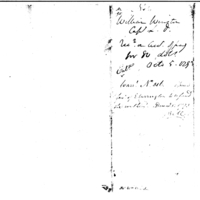
Receipt of Captain William Winston for pay from Secretary of War witnessed by Carrington
Winston received $80 pay from Secretary of War Knox by hands of Edward Carrington. -
United States Relieved from a Heavy Expense
After being warned of the danger of the fever at Philadelphia, the Chickasaw delegation have cancelled their trip to meet the President which saves the United States the expense of their journey. -
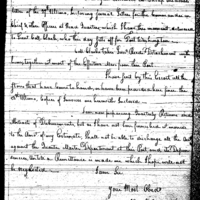
Philip Audebat letter; Lieutenant Colonel Clarke; Stores Gone Forward
Received Philip Audebat letter. Lieutenant Colonel Clarke has set off for Fort Washington with Lieutenant Reed's detachment. Has sent stores forward. Is preparing quarterly returns. -
Delinquent Deliveries and Accounts; Absent Secretary of War
Provides summary of deficient deliveries. Discusses balances and estimates. Secretary of War will be absent at least for a month. Mentions stationary, nails. Ewing's trunk will be taken to Patterson. Post script notes that all deficient articles have gone forward. -
Letter from James Seagrove Creek Indian Agent, to Georgia Governor Telfair on efforts by Georgia militia to prevent Seagrove from meeting with Creek Chiefs
Addressed to Georgia Governor and Commander in Chief of State of Georgia Edward Telfair, Seagrove implies that Telfair has been disingenuous with Seagrove. Seagrove recounts instances whereby Georgia Militia attempted to intervene and prevent Seagrove from meeting with the Creek leadership. Seagrove is dismayed that, after meeting with Telfair, and explaining President of United States General George Washington's policy guidance with regard to southern tribes, as conveyed by Secretary of War, he nonetheless required an armed federal escort in order to protect Seagrove from harm by the people of Georgia. Seagrove describes the acts of Georgia militia Colonels Lemar, Alexander and Metlon, who crossed the Oconee and surprised and attacked Indian town of Little Oakfuskee on the Chattahoochee River. These people, Seagrove notes, are under The White Lieutenant, longtime friend of the Country. Seagrove recounts tales of whites scalping Indians, taking female prisoners, plundering and burning, and preventing Seagrove from meeting with Creek leadership in order to effect a peace. Seagrove dismayed that no effort was taken by the Governor to protect a himself, a federal officer. Seagrove further dismayed to find that while Seagrove is on a peace mission, the State of Georgia is conducting a military offensive against the Creeks. Refers to Telfair's "conditions for peace," submitted while Seagrove was embarked on his peace mission [maligns Telfair's motives without saying so]. Asks that female Indian hostages be returned. Copy certified by Seagrove. -
Salaries of Howell and His Clerks
Kean is asked to advance $1020.11 to Joseph Parker, the assignee of Joseph Howell, for the salaries of Howell and his clerks for the period from July through September 1793. This sum should be charged to a separate account with the Treasury of the United States. -
Statement by Brigade Major Buckner Harris, 1st Brigade, 1st Division to James Seagrove Creek Indian Agent
Harris states that a party of militia brought in 8 prisoners and killed several Indians, which was consistent with the orders of Georgia Governor Telfair, who instructed several officers on the frontier that they should pursue any Indians who stole horses or committed hostilities. Telfair also instructed Harris to inform Brigadier General Clarke to pursue and kill any Indians committing outrages. Seagrove certifies as a true copy. -
Letter Citation
Cited in Freeman to Simmons, 02/13/1799. Freeman reports that James Seagrove Creek Indian Agent is being prevented from going over to meet the Creeks by Georgia militia. The Cherokee have invited the Creeks to go to war against Cumberland. Reports on Georgia Governor Telfair's conditions for peace. Gives an account of the horse militia going after Indian horse thieves and the subsequent destruction of a Creek Town. Freeman believes it was a Coweta town. Surmises that this will probably put an end to Seagrove's peace efforts. Attaches Georgia Governor Telfair's conditions for peace with the Creek Indians. Captured property and contracts restored; prisoners returned; perpetrators of murders (13) be surrendered; requires 10 headmen of the lower Creek Towns as hostages until requirements fulfilled. State of Georgia will not recognize peace without commissioners at the treaty. -
Governor of Georgia writes to Secretary at War regarding Indian hostilities
Governor Telfair forwards information regarding Creek crimes to Secretary Knox. Telfair states to Knox that Indian prisoners will be treated humanely. -
Letter Citation
Cited in Howell to Freeman 05/09/1794 -
Copy of a Letter from the Secretary of War To the Governor of Virginia
Information from Thomas Holt on possibility of Negro uprising. Offered guard over small magazine in New London, Virginia and all expenses related to protection from uprising to be paid for by U.S. -
Information on Negro Rebellion
Secretary Knox was informed by Thomas Holt of Virginia that some Negros planned to "rise in rebellion." Conveys this information to Governor Lee of Virginia. Letter is partially illegible. -
Inflict Due Punishment on Them
"In answer of yours of the 27th instant, which I acknowledge to have received, I hold it would be proper to follow the trail of that large party of Indians who massacred Caveat's family on the 25th instant; and, if possible, inflict due punishment on them. The country is to be defended in the best manner we can, comporting with my general instructions to you of the 17th instant." -
Clothing Received in the Months of July-October 1793
Clothing Received in the Months of July, August, September & October 1793. -
House & Stores on Water Street
Since the lease that Hodgdon currently holds on Steinmetz's house and stores on Water Street will expire at the end of the year, he wants Hodgdon to know that the current rent of 250 pounds per annum will continue if he chooses to maintain possession. Payments will be made on a quarterly basis and Hodgdon should know that the rent is not higher than that on other property of equal value. -
Letter Citation
Cited in Steinmetz to Hodgdon, 02/05/1794. -
Capt Sedam's Stores, Etc.
Hunt does not believe the wagoner will be permitted to pass through Trenton or over the ferry. However, at the ferry above Trenton they pass everyone that applies at Brunswick. Capt. Sedam should receive the stores two or three miles out of Brunswick. The carter can buy what he wants on the road to maintain himself and Harris. -
Pay warrant and receipt for salaries of the War Office
Account, War Office salaries. Pay warrant is dated 30 September and the receipt is dated 2 October 1793. -
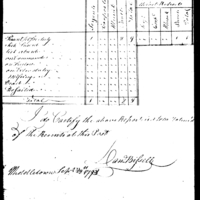
Weekly report of recruits under the command of Ensign Bissell at Middletown.
Report, Weekly report of recruits at Middletown; -
Extract of letter from Major Henry Gaither to Joshua Meals, Merchant, Augusta
[In quotation marks], letter from Major Gaither informs merchant Joshua Meals that Gaither will leave for the Oakmulgee next day and will need to furnish James Seagrove with a guard, pack horses and will likely have to accompany Seagrove himself in order to provide protection from several parties of militia. -
Captain Fauche writes the Governor regarding Indian crimes
Captain Jonas Fauche reports his military activities to the Governor. Also, Fauche passes intelligence gleaned from Indian women and children taken captive. -
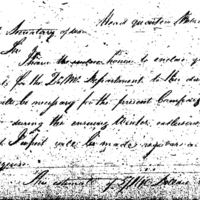
Encloses Quartermaster Statements with Seasonal Requests
Encloses statement of disbursement for the Quartermaster Department with necessary requests for this season. Discusses quality of stores, particularly cavalry clothing. -
Letter Citation
Cited in Knox to Sargent, 10/13/1793.