Seagrove reply to letter from Major Flournoy dated 5 October 1793. Notes that no treaty is in contemplation between United States and Creek Nation. He states that his actions are governed by orders of President of United States General George Washington, which are to obtain full satisfaction for injuries as a precondition for peace. Governor of Georgia Telfair, who has the power to promulgate those matters, has not done so.
Will try to assist in returning negro boy named Cooper, stolen by Creeks, and expresses condolences for the death of Flournoy's father, killed by Indians.
Notes Legion's position threatening Miami villages and Indian town at Au Glaize, saying this protects frontier and supply convoys by keeping Indians close to protect their homes, rather than venturing further to attack U.S. settlers or Legion supply shipments. Hopes to capture or reduce Au Glaize soon, and build a fort at the place. Expresses opinions on Kentucky mounted volunteers. Notes that he has not received instructions since Sept. 3, and has directed that supplies be laid in. Declares that a new post at his location, Greeneville, is almost complete; worries over fate of Col. Clark and clothing shipment, as it is sorely needed. Reports Indians hard to find. Notes that many enlistments expire within the next 9 months, and urges recruitment to fill out the Legion -- but other than that requests no reinforcements.
Jefferson encloses for Knox's examination and wisdom a letter on a subject that has already been examined and approved by the Secretary of the Treasury. Knox's clerk will retain the proofs copy. It is agreed that the letter should be sent to Mr. Hammond.
Detachment has marched from Carlisle to Pittsburgh. Hopes they arrive in season to descend Ohio River before onset of ice on the river. Light boat well manned will be wanted for conveying dispatches to Head Quarters. Hopes Lieutenant Whistler's party can be used as convoy. Encloses letters for Governor Isaac Shelby of Kentucky.
Directs that arms, ammunition, accoutrements, & clothing be sent to a man in Lancaster, with an equal amount to go to Carlisle [presumably Pennsylvania in both cases]. These are intended for the recruits now marching to those places.
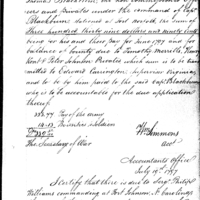
Kean is asked to advance to Samuel Hodgdon four thousand dollars on account of supplies of the War Department, for which sum James O'Hara or Hodgdon is to be held accountable. This sum should be charged to an account with the Treasury of the United States.
Letter, discusses boundaries in which naval interdictions are to made and the U.S. policy toward by belligerent nations; discusses foreign affairs; discusses maritime boundaries.
Knox establishes the distance of one league from the coast as the limit of the protection of the United States from foreign belligerents interfering with neutral vessels.
Butler asks to be excused for not answering Hodgdon's letter respecting the load of public clothing that had been lodged near Carlisle. For sixteen weeks he has been more likely to march to the Other World than to live but seems to be recovering and has returned to the works. The clothing has been sent forward. He prays God that Hodgdon and his family have avoided the malignant disease [smallpox} that has afflicted Philadelphia.
Enclosed is the receipt roll of the men under Capt. [Isaac] Guion at Gallipolis for the money sent to him from Legionville by order of General [Anthony] Wayne for the pay of his detachment for the second half of 1792.