
Collection
Transcription Project
-
Accounts Must Be Prepared According to the Comptroller's Instructions
Howell admonishes Swan that he must be attentive to that part of the Comptroller's instructions which specifies the mode that accounts are to be prepared for submission to the Accountant's office. A current account is to be forwarded with each transmission of Swan's vouchers, and the balance must agree with Swans books at the time of transmission. -
Little Good to the United States
McKee reports that the Cherokee chiefs have gone to Walnut Hills where deputations from the Creeks, Chickasaws, and Choctaws have agreed to treat with the Spaniards. McKee anticipates little good to the United States from this conference because, although the Spanish government sincerely wants peace, there are other Spaniards who are secretly fomenting acts of hostility by the Indians against the United States. -
Letter Citation
Cited in Stagg to Burbeck, 03/16/1794. -
Statement of Secretary of War to President of United States relative to South Western Frontiers
Knox recounts that during November 1792, Creek Indian Agent James Seagrove was successfully pursuing peace efforts with the Creek Nation until prospects were clouded on 11 March 1793 with the robbery and murder by Seminolas Indians at Robert Seagrove's store at Traders Hill on St Marys. Governor of Georgia Telfair called out Georgia Militia for protection of inhabitants. Knox relates that he advised Governor Telfair of the President Washington's policy considerations, based on events to the north with the Sandusky Conference and with foreign powers in general. Governor Telfair was authorized to call up 100 infantry and 100 horse of the State Militia for defense. Knox notes that cases of invasion of a state by Indians must be referred to the provisions of the United States Constitution. Points out that federal arms and ammunition were shipped to Georgia in response to the Governor's request, intended, Knox points out, as a provisional measure in case the state should be invaded. That on 12 June 1793, the Governor transmitted information regarding an intended expedition into Creek territory which proved unsuccessful due to lack of provisions. That on 13 August 1793, Georgia Governor held council of General Officers on subject of reducing five Creek Towns, which President Washington subsequently disapproved of as being unlawful and against his policies with regard to foreign affairs. That on 2 October, the Governor reported that Georgia militia surprised a friendly Creek town, killed some warriors and took some prisoners. James Seagrove endeavored to go into the Creek Nation to obtain punishment of culprits and to work out a peace arrangement with the Creeks, which was opposed by some Georgia whites. Knox recounts Governor Telfair's conditions for establishment of peace, which included assignment of commissioners. Points out that Governor raised more troops than he was authorized and brings up the question of expenses and whether to Federal Government should be obligated to pay. Suggests that, based on letters from Freeman, Major Gaither and James Seagrove, the Creeks are generally disposed for peace. Brings up questions of payment of troops and for provisions, and Constitutional questions regarding a Governor's right interfere in a treaty. Regarding the South West territory. Describes a limited state of war with the Cherokees, but also positive prospects for peace, which was broken by the actions of Captain John Beard, who defied Governor Blount's orders. Refers to the great numbers of militia brought into service and the associated costs. Knox also suggests that it will be with an ill grace that Indians are punished while the white perpetrators escape with impunity. -
Payment of Officers
Improper method of payment discussed, request for money, locations and amounts of money required by several paymasters. -
Pleading for Orders, Backpay & New Recruits; Defenses at Greeneville Complete, and Expectations of Indians to Fight or Deal
Laments lack of word from Knox, which he attributes to an epidemic in Philadelphia; also laments continued unreliability of contractors. Reports defenses at Greeneville complete, and believes Indians will fight or submit to negotiations by Jan. 1. Notes continuing problem of expiring enlistments and efforts to reenlist veterans; pleads for the 7 months' back pay due to the troops. Hopes that the Philadelphia sickness has caused this delay, from a wish not to infect the troops with contaminated currency. Notes problems of indiscipline and inebriation among the Legion, but vows to eradicate them. -
Auditors Conclusions
Well founded complaints caused auditor to be employed, but no deficiencies were found in pay made to 4th sub Legion. -
Statement of the non commisssioned officers and privates in the service of the United States.
Major General Wayne has 3229 troops under his immediate command, including the garrisons of Fort Washington, Fort Hamilton, Fort St. Clair and Fort Jefferson. At Forts Knox and Steuben: 104 Upper parts of Ohio: 113 Recruits on march to Pittsburg: 95 Recruits at the several Rendezvous: 53 West Point: 31 Southwestern territory: 79 Georgia: 157 Deficient: 1259 Establishment: 5120 Note: Major General Wayne in letter dated 5 October 1793, states that effective force, independent of sick, garrison and officers: 2600. Effective mounted volunteer officers under General Scott [Kentucky]: 1029 -
Submission to House of Representatives Knox's instructions to the Federal Commissioners appointed to treat with Indians north of Ohio, their reports, and statement of troops of Legion of United States and certain intelligence from Major General Wayne
Ordered by President of United States General George Washington, Knox submits to the Speaker of the House of Representatives his instructions to the Federal Commissioners for the Sandusky Conference, their journal reports, statements regarding troops in Legion of United States and intelligence from Major General Anthony Wayne. -
Instructions to the Commissioners, Etc.
"In obedience to the direction of the President of the United States, I have the honor to submit to the Senate the instructions to the Commissioners appointed to treat with the hostile Indians north of the Ohio and their report in the form of a journal of their proceedings. And also a statement of the troops of the legion of the United States and certain intelligence from Major General Wayne." -
Fifth Annual Address to Congress by the President
This is President Washington's fifth annual address to the Congress of the United States, now called the "State of the Union" address. He discusses foreign relations particularly in regard to the war in Europe and its effect on American intercourse, Indian affairs with the northern and southern tribes, and payment on the debt to Holland. -
Letter Citation
Cited in Howell to Craig 01/02/1794 -
Howell discusses funding and pay matters with Major Craig
Joseph Howell discusses pay matters with Major Craig. -
Letter Citation
Cited in Howell to Craig 01/02/1794. -
An Act directing a Detachment from the Militia of the United States
Outlines the regulations for states to call up militias. -
Extraordinary Compensation for Cloth of Superior Quality
" The dealer's catalogue description of this letter reads; 'Regarding the account of Young & Danacker for surplus clothing furnished for the use of the army. As it appears that the clothing for the Sergeants and musicians has been made of cloth of a very superior quality, it is my wish that [they] be allowed an extraordinary compensation therefore...'" -
Equipage for Capt. Kersey
Stagg lists articles needed by Capt. [William] Kersey at the rendezvous at Spring Garden. -
Baron's Military Instructions
Stagg announces that they have none of the Baron's [Von Steuben] Military Instructions and only four copies remaining of the Articles of War which they want. A number of the Military Instructions were sent to the army. -
Letter Citation
Cited in Howell to Freeman 05/09/1794 -
Notes from Knox for Presidential speech
Document, draft suggestions for President's speech on National Defense; discusses hostile Indians on frontier; establishment of energetic militia; and fortification of seaports. -
Peace and Understanding Re-established
Seagrove notifies Governor Telfair of the re-establishment of peace and friendship with the Creek nation which includes the understanding that all prisoners and stolen property will be returned. He wants the Governor to waste no time in promulgating this welcome news to prevent outrages from being committed against the Indians which would endanger the fragile peace. -
Acts of Hostility and Depredations Must Cease
Seagrove reports on his visit to the Lower towns where he was received with warmth and friendship but if reconciliation is to be attained with the entire Creek nation, transgressions and depredations by both whites and Indians must be halted and those guilty of misdeeds on both sides must be punished. -
Derangement of the Department
The accounts Hodgdon lodged in Harrison's department as late Quartermaster General have been examined but a statement has been prevented by the late derangement of the department. They will be taken up and adjusted as soon as more urgent business allows. Some corrections and alterations will be made but to no considerable amount. -
Clothing & Equipage
Hodgdon has informed Sedam that the clothing and equipage are ready and wants to know when they should be sent on. Sedam thinks that the matter should rest for a few days since he will be in Philadelphia soon and can learn the opinion of General Knox. -
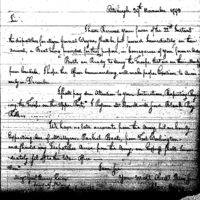
Dispatches for Major General Wayne; Pay Matters
Dispatches for Major General Wayne will be sent forward upon arrival. boats are ready to carry the troops on the march from Carlisle. Will pay attention to instructions respecting paying the troops on the upper posts