
Collection
Transcription Project
-
Sums Deducted from Advances to Officers & Soldiers
Howell wants to be furnished with certificates of the sums deducted from his advances to the officers and soldiers as shown in his own account. Swan's certificates should indicate the company and corps in which the officers and soldiers are arranged. -
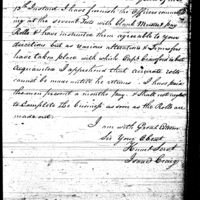
Craig discusses funding and currency with Howell
Major Craig discusses the distribution of blank muster pay rolls with Joseph Howell. -
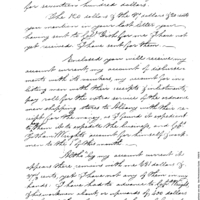
Sends his accounts
Cover for several accounts - account current, account of disbursements, account for enlisting men; a pay roll; and the account of Capt Wright. Discusses his account current -
Spirits for the Use of the Army
Hamilton directs Coxe to purchase spirits for the use of the Army from the supplies lawfully distilled in Pennsylvania, Virginia, and Kentucky. -
Letter Citation
Cited in Howell to Freeman 05/09/1794 -
Knox requests meeting with Sayre
Letter, asks Sayer to come to office to discuss Sayer's recent letter. -
Information Relative to the Southwestern Frontiers
"In pursuance of directions from the President of the United States, I have the honor to submit to the Senate further information relatively to the Southwestern frontiers." -
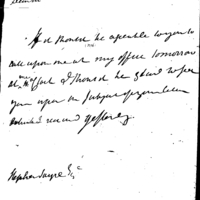
Sayre meeting with Knox
Knox will meet with Sayre at his office the next day at one o'clock. -
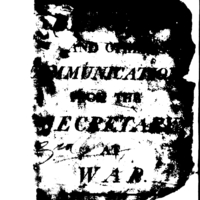
Table of Contents Volume II, including instructions to commissioners appointed to treat with Indians north of Ohio, statement relative to Southwestern Frontier & the Creek and Cherokee Indians, letter accompanying return of ordnance and military stores of United States
Table of contents includes instructions for commissioners appointed to treat with Indians north of Ohio [Sandusky Conference], and a journal of the proceedings; a letter from Secretary of War Henry Knox accompanying a return of ordnance, arms and military stores of United States; and statement relative to the South Western frontiers as connected with the State of Georgia and the Creek Indians, the South Western territory of the United States and the Cherokees, in a variety of communications, from A to I, inclusive. -
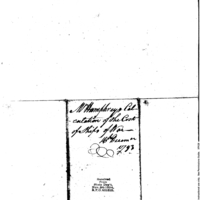
Calculation of the cost of constructing ships of war
An influential shipbuilder calculates the cost of building and maintaining a frigate for the United States. Estimates 23 pounds per ton. -
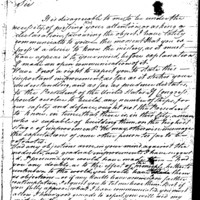
Regarding the construction of ships for defense
Sayre suggests that if Congress is to approve building of frigates, that the President ought to know who is capable of building them on the highest stage of improvement. -
Arrangement for the Pay of Commissioned Officers
Enclosed is the arrangement for the pay of the Commissioned Officers of the Army. It should be noted that the payments intended in this arrangement will be facilitated by the transmission of the muster rolls. A delay would defeat the convenience intended by the regulation. Each officer should appoint an attorney or some other person to represent him at the seat of government if he is unable to represent himself. -
Report on the Southwestern Frontier and the Creek Indians
Report relative to the Southwestern frontiers of the United States, as connected with the State of Georgia and the Creek Indians, and the territory of the United States South of the Ohio and the Cherokee Indians.Knox believes that, with the exception of a few lawless banditti Indians, the Creeks are amenable to a peaceful settlement and if the depredations of several lawless whites can be inhibited, peace on the southwestern frontier can be achieved. -
Henry Knox to President of United States George Washington: recommendations on locations of arsenals and magazines, development of a national arms industry, and return of ordnance, arms and military stores in possession of United States
Included in this return are some recommendations regarding strategic location of magazines and arsenals across the United States and the importance of developing an arms industry in the United States. The state of returns he owes to the casual circumstances of the War for Independence. Principal locations: New London Virginia, Philadelphia, West Point on Hudson River and Springfield on Connecticut River in Massachusetts. Describes the important circumstances for location as security from external and domestic enemies, and easy access by water, including the sea. New London is a poor location; perhaps James River with access to sea would be better. Population centers can be dangerous; hence ammunition will be move up the Delaware River. West Point is not a good choice because of easy [enemy] access from the sea. Hence a plan to move to Albany. Land transportation costs make Carlisle Pennsylvania an unattractive location. Recommends that the country have three permanent magazines located in east, middle and southern parts of the country, with subdivisions. United States should possess100,000 arms in its arsenals, with battering and field artillery and ammunition in ample proportion. Discusses the importance of a national arms industry. Higher costs outweighed by skills developed and security provided. Returns of ordnance and stores and shot and shells are provided for the following: Springfield Massachusetts, West Point New York, Fort Rensselaer Albany New York, Philadelphia Pennsylvania, Carlisle Pennsylvania, Mount Hope Forge New Jersey, Rockaway Forge New Jersey. Balsto Furnace New Jersey. In Pennsylvania: Durham, Oley, Berkshire, Cornwall, and Mary Ann Furnace, Pittsburg, Fort Franklin. In Maryland: Johnston's Ferry, Baltimore, Elkton, Turner's Creek, Georgetown In Virginia: New London, Manchester. Western Territory [Ohio]: Fort Washington, Fort Hamilton, Fort St. Clair, Fort Jefferson Principle articles delivered since the last general return dated 7 October 1789. Items forwarded include muskets, powder, musket balls, and pig lead to the following: to the army, to the states of Georgia and South Carolina, to the Southwestern Territory, to the Minister of France for the use of the French Colonies -
Stop the Money from Capt. Melcher or I Shall Lose It!
Enclosed is an extract from the list of warrants issued by the Secretary of War in continuation through November 1793. Howell also want to know if Swan has stopped the money from Captain Melcher. This must be done or Howell will lose it. -
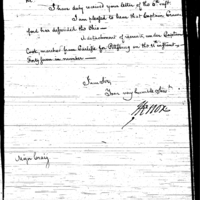
Captain Crawford's Descent; Detachment of Recruits Marching
Pleased to hear that Captain Crawford has descended Ohio River. Detachment of 45 recruits under Captain Cook, marched from Carlisle to Pittsburg. -
Statement of Secretary of War to President of United States relative to South Western Frontiers
Statement relative to Southwestern portions of United States, connected with Georgia, Creek Indians. Begins by recounting James Seagrove, Creek Indian Agent, conference with lower Creeks in November 1792. Lower Creeks estimated at about 1000 people. Purpose of conference was to confirm Treaty of New York and to administer necessities, corn and clothing. The meeting was a success and Knox notes that prospects for peace were favorable until the robbery and murder at Robert Seagrove's store Traders Hill, St Marys 7 March 1793 by a party of about 30 Simanolas. As a consequence, Governor of Georgia Telfair called militia into service. Knox then recounts that on 30 May 1793 because of larger strategic and foreign policy concerns, the President of United States directed Governor Telfair to avoid making offensive operations into Creek Country. Knox notes that cases of Indian invasion must be referred to the Constitution of United States. That Governor of South Carolina was asked to assist Georgia in case of invasion by large bodies of Indians. That Federal Government furnished arms and ammunition to state of Georgia in case the state should be invaded. Knox recounts General Twiggs' failed expedition to the Oakmulgee. Governor Telfair's council of General Officers on the subject of reducing five inimical Creek Towns was disapproved by the President of the United States General George Washington. Knox recounts the 21 October killing of warriors and taking of women prisoners at a friendly Creek town Little Oakfuskee on the Chattahoochee River. Knox notes Seagrove's planned meeting with the Creek leadership in order to maintain the peace. The meeting was disrupted by hostile Georgia inhabitants. Knox recounts Telfair's insistence that government of Georgia cannot recognize establishment of peace without having commissioners assigned. Knox points out that Governor Telfair never raised the authorized 100 horse and 100 infantry; instead he kept a higher number of militia in service [roughly 500], which will be a considerable expense to the United States Government. Notes that based on what he heard from Constant Freeman and Major Henry Gaither, the Creeks in general are disposed for peace; some lawless whites are deliberately disrupting the peace. Knox raised the issue of responsibility of payment of militia, the constitutionality of states opposing federal treaties, and the wisdom of a long and expensive war with the powerful Creek Tribes. Second part of letter discusses territory of United States West of the Ohio and the Cherokees. Notes that Governor Blount made positive strides in creating peace with Cherokees in 1792, but on 12 June 1793, Captain Beard, called into service to protect the inhabitants, defied orders, crossed the Tennessee River and killed a number of Indians. Knox laments that the white perpetrators of injustice against Indians will likely go unpunished, the past and future expenses of paying and sustaining militia forces -
Calamity Which Befell the Vessel
[Difficult handwriting] Hodgdon has been informed of the calamity which befell the vessel in being cast away. The men were sent to Norfolk where they remained until Mr. [Joseph] Perkins went down to pick them up. -
Craig discusses military stores and shipment with Hodgdon
Major Craig requests money from Samuel Hodgdon. Craig needs five thousand dollars to close his transactions for the year. -
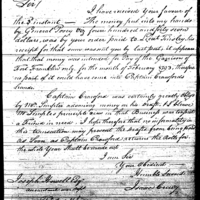
Craig discusses funding and currency with Howell
Major Craig confirms receipt of monies sent by Joseph Howell. -
Pay of Matthew Ernest
Ernests asks Howell to give to John Wilkins, Jr. the amount ordered in his favor by Dr. Richard Allison and transmitted to Howell by Caleb Swan from Fort Washington. -
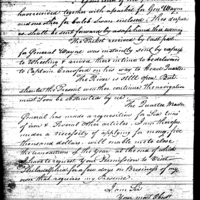
Major Craig sends status report from Fort Pitt to the Secretary at War
Major Craig informs Secretary Knox of his funding requirements and the Major also requests permission to visit Philadelphia on personal business. -
Muster, Payrolls and Detention of Pay
Discusses officers at the Upper Posts of Ohio River. Should be enabled to make out authentic muster and pay rolls. Wants to put that part in train without delaying Captain Crawford's return as they are much in want of money. If they do not execute, the detention of pay will be their fault. -
Regarding the cost of shipbuilding materials
Requests the cost of shipbuilding materials, including equipment and labor. -
Table of Contents: Report of the territory of the United States Southwest of the Ohio, and the Cherokees.]
Table of contents for subsequent reports and letters: Section A: Knox to President of United States General George Washington relative to southwestern frontiers. Sect. B: Knox to Governor of Georgia and Governor of South Carolina. Sect C: Secretary of War to James Seagrove. Sect D: Secretary of War to Major Gaither. Sect E: Governor of Georgia to Secretary of War. Sect F: James Seagrove to Secretary of War. Sect. sect G: Major Henry Gaither to Secretary of War. Sect H: Constant Freeman to Secretary of War. Sect I: Secretary of War to Governor Blount and Daniel Smith Sect K: Governor Blount to Secretary of War Sect L: Daniel Smith to Secretary of War