
Collection
Transcription Project
-

Estimates of the expenses of building and equipping frigates
Letter, discusses three estimates of the expenses of building and equipping frigates. -

Estimates of expenses of building and equipping frigates
Encloses estimates of expenses of building and equipping frigates. First one was made in Philadelphia and is described as most perfect. Second is estimate made in Boston; fairly accurate, but not comprehending all the equipment. Third is tolerably accurate. -

Enclosed Vouchers
Pay roll received, agreeable to instructions by Howell, Bissell enclosed recruiting information and vouchers. -

Major Craig sends status report from Fort Pitt to the Secretary at War
Major Craig informs Secretary Knox that detachments under the command of Captains Cook and Thompson have arrived at Fort Pitt and that the whiskey ration for the troops has been commenced. -

War Office Salaries, October, November & December 1793
Document, receipt documenting salaries paid in the War Office. -

Craig discusses military stores and shipment with Hodgdon
Major Craig acknowledges arrival of the Quartermaster General and receipt of five thousand dollars sent by Samuel Hodgdon. -

Twenty Suits of Infantry Clothing
Hodgdon is directed to have packed up and transported to the recruiting service at Lancaster, addressed to Ensign Levi McClean, twenty suits of infantry clothing, leaving out the linen overalls. Also forward to the same address twenty stands of arms and accoutrements. -
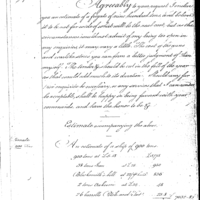
Estimate for building and equipping a ship of war from Thomas Fitzsimmons
Fitzsimmons agrees to provide estimates for building and equipping a ship of war. He promises to send the estimate next morning. -
Indians attacked by whites
Capt. Richard Roberts writes the Governor of Georgia on the vicious attack against a band of hunting Creek Indians by a group of whites under the command of Capt. Jonathan Adams. Roberts details what happened. -
Testimony on the white attack on Indians
On December 28th a party of whites murdered two Creek Indians hunting in Georgia who had neither attacked them nor threatened them. Bartlet Walker, aged 16 years, testifies that Capt. Jonathan Adams and three others fired upon and killed the Indians. -

Employment in the Gun Business
Joseph Perkins published in the Virginia Herald an advertisement for men skilled in the gun business to be employed in New London. He left thirty dollars with Legg to employ as many workmen as he could. Legg asks Hodgdon to provide the necessary money to carry the advertisement into effect. So far only two men have been engaged. -
Indians attacked by whites
Letter to the Secretary of War regarding the attacks upon the Creek nation by a party of whites in Georgia. -
Treaty with Northwestern Indians
The Secretary of War writes the President of the United States concerning a treaty with the Wabash and Northwestern Indians; mentions that most of the principal chiefs of the Wabash Indians who visited Philadelphia died of smallpox afterward. -
Letter from the new Secretary of State
Edmund Randolph, having just taken his oath of office as Secretary of State, writes Alexander Hamilton and Henry Knox, also in Washington's cabinet. Randolph replaced Jefferson, who openly disagreed with Hamilton while Secretary of State, so Randolph promises to largely keep his own opinions to himself. -

Payroll Procedures
Clarifies meaning of letter respecting William Sample's business. Describes payroll procedures. Regrets that he cannot arrange the business to Mr. Sample's perfect satisfaction. -

William Semple's Business
Howell discusses the War Department's business with William Semple, complications from which make it impossible to resolve Semple's account to his perfect satisfaction. -
Accounts of Ensign Lowther
Howell discusses the account of Lowther about which it was mistakenly believed that he had broken his parole and therefore justice was not done to him. -

Pattern Coat & Vest for Sergeants
The Secretary of War directs Hodgdon to send to his office the pattern coat and vest for sergeants. The contractors have brought some cloth samples which they propose as substitutes. Mr. Stille has been asked to be present at the examination. -
Indians attacked by whites
Informs the Governor of Georgia of an unfortunate event harming the state's relationship with the Creek Indians. On December 28th the White Bird-tail king and eight Cussetahs, encouraged by assurances of safety from Mr. Seagrove, were hunting when two of them were treacherously murdered by a party of whites. Three white men had appeared to the Indians without arms. The Indians received and entertained them in a friendly manner and gave them something to eat. After staying some time with the Indians, they left them, and returned, with their arms and the rest of their party, firing upon and killing two of the Indians. -
Articles of Agreement
Articles of Agreement between Alexander Hamilton and Robert Elliot and Elie Williams. -

Pay Rolls and Muster Roll
Updates on accounts kept by Bryant for Company in Springfield, location of accounts in military stores. -
Indians attacked by whites
Informs the Secretary of War, from Georgia, that an unfortunate event on December 28 has destroyed hopes for peace between the United States and the Creek nation. The Bird-tail king and eight of his town were treacherously attacked by a party of whites, killing two Creek Indians. -

Rental charges incurred by War Department
List of rent charges incurred by War Department, owed to John Steinmetz. The list is provided by the Commissary of Military Stores. -

Speech from U.S. envoy to Indians at Venango
Speech, discusses Indians and war. -

Letter from Timothy Bernard [Bernard] to Henry Gaither Major Commandant on the state of affairs on the frontier, the prospects for peace, and whether military operations will make distinctions between Creek friend and foe
Undated letter, presumably written spring or summer 1793. Barnard discusses the danger of traveling, presumably in the aftermath of the robbery and murder at Traders Hill St Marys. Matters may have to be settled by an army coming against the offenders. Does not see war as general yet. Hopes that distinctions can be made by army between hostile and peaceful towns. Cussetahs want peace. Mad Dog of Tuckabachees, Upper Creeks, and headmen of upper towns have sent good talk. Cowetas were set to do mischief, but Cussetahs turned them back. Large party from upper Creek town gone high up Oconee. About 2000 Upper Creeks have gone out against the Chickasaws. Closes by asking Gaither if he believes military forces, in retaliating, will make a distinction between Creek friends and enemies. Barnard has friends, family and the Cussetahs themselves, who would like to know what to expect in this regard.