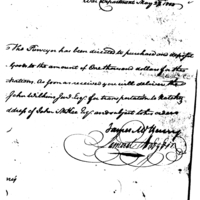
Requests that John Wilkinson, Quartermaster General, deliver suits of artillery clothing, swords, belts, and a flag to Charles Wollstonecraft, paymaster of the 2nd regiment.
For room furnished to Captain Ellery for 9 and 1/2 weeks. Hamilton asks that Ebenzer Stevens reimburse Captain Ellery. Ellery notes he received $38 as reimbursement.
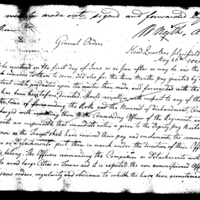
This General Order prescribes the date and manner in which troops are to be paid for the three months enlistment authorized by the Act of Congress and discusses the way in which pay is handled for those who are casualties of war. As soon as the troops have received their pay and emoluments, their commanding officers shall put them under march. The officers will endeavor to avoid marching through large cities or towns.
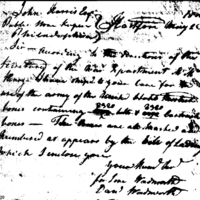
Informs Whelen that the 100 bags of saltpeter sent for refining into gunpowder were received, and that tests have been undertaken to see how much pure saltpeter may be gotten out of the unrefined substance.
Opinion that Negro woman is private property, information on private accounts of Benjamin Hawkins. Requests orders on how to act if Indians were to engage the U.S. in war, cites his location as badly supplied and dangerous.
The Superintendent of the Armory has drawn on Williams for five thousand musket stocks so he shall soon be in want of that article. He asks Hodgdon to ship that same number of well seasoned stocks to Springfield as soon as it is convenient. The Superintendent has also drawn a large quantity of rolled iron for bands so that should be forwarded with the gunstocks.
States that he cannot determine anything concerning the claims of Major Tousard and Silas Dinsmore. Desires to commission Tousard as both Lieutenant Colonel and Inspector.
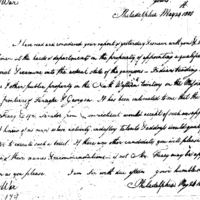
Adams concurs with the communicated judgments of the department heads [Cabinet] on the necessity of appointing a qualified person to inspect government property and installations along the frontiers. Asks for the names of candidates to be sent to him, and recommends a senator from Connecticut as one candidate.
Responds to a letter concerning appointments for Major Tousard. Adams states that he will omit appointing any officer in the artillery, except for Robins Chamberlain. Notes that he will inform Benjamin Stoddert and McHenry's successor of a petition by Robert Gilmore.
Stagg assures McHenry that he felt only kindness and indulgence from him as an employer, especially during "a long and unavoidable absence." States that McHenry's words or actions had nothing to do with his [Stagg's] resignation, citing rather poor health and the seeking of a better opportunity with which to support his family.
In light of recent rumors that McHenry had pressured Stagg into resigning as chief clerk in order to promote his brother-in-law to the position, McHenry had asked Stagg to formally renounce any truth behind the rumor. Stagg responds by stating unequivocally that McHenry did not cause his resignation, blaming his state of health instead.