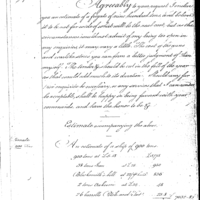
Despite the prevalence of some opinion that disapproves of General Wayne's conduct, the Secretary of War informs Wayne that Washington fully approves of his efforts. Knox insists that it is unlikely that there will be war in the upcoming months. Knox also briefly discusses the report of the Committee for a bill creating a United States legion, which Knox disapproves of.
Knox addresses the United States Senate regarding the petition of Elkanah Prentice. Prentice claims he sustained injuries to his leg due to hardship and fatigue, which left him a cripple for life. Knox suggests that Prentice may be entitled to benefits provided by the Resolve of Congress 23 April 1782 if he can produce evidence of the discharge papers that placed him on the invalid list.
Henry Knox informs noted French architect Peter Charles L'Enfant that he has been appointed temporary engineer for the purposes of fortifying the ports of Philadelphia and Wilmington, Delaware.
Have forwarded to West Point for the soldiers enlisted by Captain George Fleming of the ordnance department, suits of infantry clothing for one sergeant, one corporal, and 18 privates.
Asks that the enclosed letter be transmitted to the Agent for Fortifications and the mounting of guns in Portsmouth, New Hampshire, and for that person's name to be reported to Knox [the Agent was, in fact, the same Joseph Whipple].
Requested delivery of enclosed letter to the person Williams appoints to, "disburse the money intended to be expended at Baltimore" for the fortifications and mounting of cannons.
Noted preference given to older officers for certain tasks before mentioning Captain Snicker, of Baltimore. Advised the appointment of a French officer to survey cannons at Whetstone Point. New cannon carriage invented.
Discusses accounts and pay as a muster master. Laments how busy he is; cannot devote a day in a month to private business. Mentions muster rolls and procedures. Indians have done a good deal of mischief. Mentions the matter of settlements and General Robertson.
Writes General John Lamb - the Collector of the Port of New York - concerning the appointment of an engineer for the purpose of fortifying the harbor of New York.
Secretary Knox refers to Hackett's construction of the well-regarded Revolutionary warship "Alliance" and asks that he come to Philadelphia for consultation on construction of large-sized frigates. Expenses will be paid.
A general return of the situation of the fortifications of the seaport towns in the states of New England, including Connecticut, Rhode Island, Massachusetts, New Hampshire, Maine and New York. The document stresses the importance of fortifications at Newport, Rhode Island, in the event of war, advising that they be strengthened. The importance of New York is also stressed.
The US Congress gave the President the power to claim land from states upon which fortifications have been erected. Thus the General Assembly grants the United States claim to the lands on which fortifications lay on Goat Island, and any adjacent lands that have been improved by the state for the purposes of defense.
Additionally, it is deemed lawful by the General Assembly for the Town of Newport (in the jurisdiction of which Goat Island falls), as well as any other town or individual in the state of Rhode Island, to sell to the United States the use of land as deemed necessary for erecting fortifications.