Hodgdon received $4000 from Howell for reenlistments of men whose terms expired, transmitted to Major Isaac Craig at Pittsburgh to be forwarded to commanding officer Fort Washington.
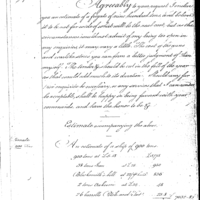
Information on and estimate of timber, planks, copper for 36 gun frigates. Knox informs Hamilton that the President of United States has decided that the frigates will be built at Boston, New York, Philadelphia, Baltimore, Portsmouth Virginia, Charleston South Carolina. Knox discusses procurement of live oak, which can be found on the offshore islands of Georgia and some in North Carolina. He notes that there are multiple opinions on the means to obtain the oak and cedar and bring it to port. Knox then discusses the recommendation to construct moulds for the ships on the offshore islands of Georgia. Discusses sending men from the north to cut the timber. He notes that his sources tell him any contracts in Georgia and southward will be executed by negroes and that their indolence and carelessness will inevitably produce disappointment or loss. Knox points out that during the Revolutionary War, timber was procured at Kilkenny and Sunbury Georgia and transported from the Savannah River for construction of 74 gun ships. Discusses workers and possibility of wage hikes and the challenges of assigning ship building contracts in the area. Discusses the shipbuilders of Philadelphia and the likelihood that they will be able to accept ship building contract. Notes that the President of United States George Washington has approved the use of agents for ship construction, presumably working under the Department of Treasury.
This letter contains an estimate of materials necessary to construct the frigates authorized by act of Congress. The Secretary at War also requests that the Secretary of the Treasury consider two modes for obtaining oak and cedar for building the frigates: by direct contract or by appointed agents. The Secretary at War mentions problems associated with utilizing slave labor.
Lieutenant Morris expresses to Howell his distress at having not been paid for seventeen months, a delay that has so exhausted his feeble resources that he has been obliged to seek credit from the contractor.
Before Wolcott would give his opinion on subject mentioned in March 17th letter from Howell he needed more info on what monies were paid to States for militias. Other question respecting Act of February 12, 1793, was submitted to Attorney General.
Lieutenant Campbell is delivering funds for the pay and forage of the troops at the upper posts of the Ohio for nine months in 1793-1794 and subsistence for 1793.
The Secretary of War informs Perault that his commission will now extend to the fortifications of Charleston and Georgetown, South Carolina, and to Savannah and St. Mary's, in Georgia. The places first to be attended to are Charleston and Savannah. Upon his arrival at Charleston, he is to send Mr. Stouff to survey the Savannah River.
Constant Freeman, agent for the War Department in Georgia, writes Secretary Knox on certain persons employed in Georgia to recruit a corps of troops for the service of France with designs toward the invasion of the Spanish Floridas.
Constant Freeman, agent for the Department of War in Georgia, writes Secretary Knox. Discusses certain persons employed in Georgia to recruit a corps of troops for the service of France, with designs toward invasion of the Spanish Floridas. Apparently the recruiting effort is not going so well, however, and "it is generally believed, by the most sensible and orderly inhabitants of this country, that the proposed expedition of these adventurers will fail."
Jones sends along the model of the cannon and carriage that was requested by the Secretary of War. It is not intended that either the platform or breastwork should be included the model.
Policy of exchange on vessels bound for foreign nations still in effect. Requests Vanderhorst will comply with the president's wishes as stated in previous letter regarding the use of the militia.