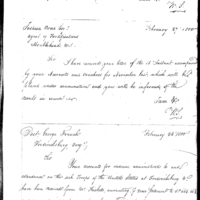
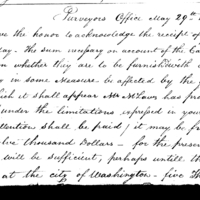
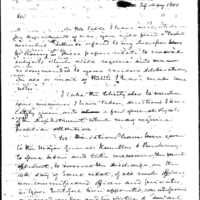
Simmons received accounts and vouchers from Crocker for the troops at Charleston. However, accounts from previous months remain suspended. Simmons wrote Mr. Craft on the missing accounts and vouchers but never received an reply and therefore Simmons wrote Crocker requesting account information immediately.
Certification of payment; $949.17 to Michael Gunkle, Contractor for Pennsylvania for rations, quartermaster, and hospital supplies and expenditures for the use of troops of the United States marching through Pennsylvania.
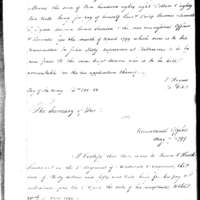
Certification of payment; $1422.85 Samuel Hodgdon, for pay of persons employed in the military store department, rent, and purchase of five standards and pattern infantry coat
Certification of payment; $226.60 to Lieutenant Nanning Vischer, 2d Regiment of Infantry, balance on settlement of account for recruiting, and payments made in Quartermaster Department, including subsistence. .
Letter from the Secretary of War in his final days in office. McHenry appears to speak in ambiguity about his successor, unknown to this point to McHenry. Samuel Dexter would replace McHenry.
Secretary McHenry thanks Little Turtle for his friendship and hopes that Little Turtle will continue his friendship with his successor and the United States.
Letter from James McHenry, former Secretary of War, to his successor. McHenry details the state of the Department and points out what needs immediate action. He discusses the state of Indian affairs, the need for a military academy, the establishment of a factory for small arms near Harper's Ferry, and other matters.
It is appropriate that the few men who enlisted "for and during the existing differences with the French" be discharged with the rest. Cited the conditions for enlisting as "inconsiderable" and that the expectation that the enlisted men would not be separated from the officers was "painful".
A letter from McHenry is reproduced in which he cites orders from President Adams to Major Generals Hamilton and Pinckney to begin reducing the twelve regiments on June 14th. The Superintendent of Military Arms will take custody of all arms and camp equipage. The Paymaster General will need information from the two Major Generals regarding the pay of the officers and men who will be discharged as a result of this force reduction.
Accounts sent to War office were meant to be settled by Treasurer. As such, the Treasurer denied claims but objections to the refusal remain firm. Since War office does not settle claims mailed by Watson, they were returned to him by Simmons.
In his last week in office as Secretary of War, James McHenry writes to a firm in London. Mentions the delivery of books and stationery to him. Makes arrangements to close the account between the firm and the Department of War. McHenry thanks them for their helpfulness during his term as Secretary of War.
Instructions for McHenry's successor - Samuel Dexter - on important matters of the War Department, including: discharge of the Provisional Army, Indian policy, supply of clothing, trading houses on the western frontier, contractors for cannon, the Corps of Artillerists & Engineers, fortifications, and the establishment of an armory at Harper's Ferry. Also mentions his desire for a National Foundry for casting cannon, shot, and shells, which he has proposed to President Adams.
Routine correspondence concerning the appointment, transfer, promotion, discharge, desertion, leave, and assignment of individual officers and soldiers.
Directs issue of clothing & a blanket to a private of the 1st Infantry now serving as a waiter to the Paymaster General. A return for the clothing, signed by Paymaster General Caleb Swan, is included.
McHenry laments the changes in the Executive officers and other steps the President has evidently taken to secure his election. [Adams] is acting in a manner to break up the federal party and will destroy any remaining confidence they have in him. He cannot hear Washington praised without intolerable pain and hates with inconceivable acrimony those who consider that great man to have outstripped him in virtuous and honorable reputation. It is certain that all of our courtesies to the opposition and measures to secure votes will not divert a single one from Jefferson.