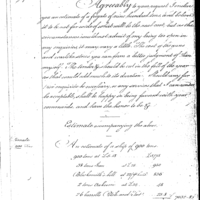
Letter from the Commissioner of the Revenue to Treasury Secretary Hamilton regarding the shipment of supplies from Europe - principally London, with alternatives in Copenhagen, Gottenburg, and Amsterdam - for the construction of six frigates.
Treasury Secretary Hamilton informs Pinckney that he has determined to import from Europe materials for the construction of six frigates. He will procure the articles from Northern Europe. Hamilton's first choice is Britain, with Denmark, Sweden, and the Netherlands as alternatives.
The bearer, James Reynolds, is an express and has arrived with dispatches from General [Anthony] Wayne. Hodgdon is directed to attend to him and his horse and also he wants some money.
Encloses invoice for goods for Israel Chapin's order as per the Treaty of 1793. The blankets were not procured in New York, but must come from Philadelphia.
Secretary Knox encloses a copy of a letter from Major General Anthony Wayne, to President Washington. Informs the President that a group of "savages" attacked an escort carrying provisions from Fort Washington to Fort Hamilton, killing 5 out of 6 of the advanced Guard, also carrying off some horses. Also informs the President that General Wayne believes General James Wilkinson might be the cause of strife with the contractors. Finally, Knox informs the President that the Six Nations continue to be dissatisfied with the Presqu' Isle establishment being planned in western Pennsylvania, and that the British have erected a post at the Miami with the idea of its being an Indian fortification.
Secretary of War Henry Knox informs Alexander Hamilton that he has appointed as naval agents Henry Jackson at Boston, Jeremiah Yellot at Baltimore, and Henry Blagge at New York. Others will be named soon. Charleston will not be one of the ports for frigate construction. John Morgan will be a constructor at and Joshua Humphreys at Philadelphia.
Treasury Secretary Hamilton informs Knox that he has appointed the following persons as naval agents: Henry Jackson of Boston; John Blagge of New York; Jeremiah Yellot of Baltimore. Also mentions that the Sixth frigate will not be built at Charleston; John Morgan will be the principal constructor at Norfolk; and Joshua Humphreys the principal constructor in Philadelphia. The others are not yet determined on.
Captain Thomas Truxton appointed a Captain of one of the frigates to be built, oath of allegiance before Richard Peters. Truxton would go on to command the USS Constellation and the USS President.
Mentions that he has sent off the last shipment of cartridge boxes & belts he was employed to procure, as shown in an enclosed bill of lading [not included]. Discusses his account with the War Department.
Governor Mifflin lectures Knox on the discretionary powers of the President in relation to the State governments. He acknowledges that it is the duty of the President to act in the interests of the whole Union even if an action might be perceived as contrary to the interests of an individual State. However, it his duty as Executive Magistrate of Pennsylvania to act in its best interest unless an action is contrary to the interests of the whole Union.
Major John Jacob Rivardi writes the Secretary of War from Norfolk, to discuss various fortifications and batteries. Includes many specifics regarding the construction and engineering.
Letter from the Governor of Pennsylvania to the Secretary of War. In it, Governor Mifflin addresses the establishment of a garrison at Presqu' Isle (now Erie, Pennsylvania), which is hostilely received by the Six Nations. Mifflin mentions that British agents, particularly under the guidance of Lord Dorchester, have "excited that hostile disposition." Mifflin is of the opinion that the settlement should continue to be suspended.