Letter to the Secretary of Treasury stating that the sail cloth manufactured in Boston is to be preferred imported sail cloth from Europe. The writer states that Boston manufactured cloth is less liable to mildew, owing to the sizing which in America is made from animal substances and not as is common in Europe from vegetables.
Letter from the Commissioner of the Revenue requesting from Hamilton an abstract of the military and Indian supplies for 1793 and 1794, which have been purchased or contracted under the direction of the Treasury Department. Due to the commencement of the "sickly season," Coxe fears that it may be difficult to procure the workers necessary for cutting the ship timber from the Northern states.
The Commissioner of the Revenue encloses his letter to Mr. White regarding Mr. Zane's iron works. Also mentions a quantity of anchors for importation of near 70 tons.
Quartermaster General O'Hara provides Hodgdon with a series of tasks that should be accomplished and updates him on the progress of the war with the Indians.
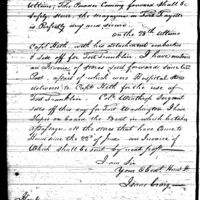
Freeman received letters addressed to recruiting officers, stated he would pay strict attention to the directions contained in them. Freeman advanced money by Supervisor of the Revenue for Massachusetts.
Letter to the Secretary of War discussing fortifications and batteries at Jones Point, Virginia, alongside the Potomac River. Vermonnet has to deal with some marshy areas.
Writes about the irregularity and uncertainty of American commerce and manufacture. Requires estimate of articles wanted for the current year, including clothing, hospital stores, tents and camp equipment, Indian supplies, and supplies for laborers. Requests paperwork for building in Boston.
Knox forwards an extract of a letter from Mr Charles Vaughn providing estimate of the price of oak plank at Boston. Refers to a source at Kennebec, presumably the river in Maine.
Proceedings of a General Council of the Six Nations, holden at Buffalo Creek. Captain O'Bail, a Seneca chief was chosen as the speaker, and O'Bail made it known that the Six Nations are a free and independent people, and are frustrated with the disputes over the boundary, particularly at Presqu' Isle. General Israel Chapin responded, insisted that President Washington is friends of the Six Nations, and that they hope the disputes will not lead to conflict.
Secretary Hamilton informs Daniel Stevens that Tench Coxe, Commissioner of the Revenue, desires Stevens' agency on the business of procuring in the state of South Carolina certain kinds of timber for the building of frigates. Hamilton has directed the Treasurer to remit Stevens bills for $11,000. These bills are only to be used in proportion as the money may be wanted for actual disbursement; it may happen that the whole of the necessary timber will be procured in Georgia.
The Commissioner of the Revenue requests that a warrant for $500 be issued in favor of John Mease on account of whiskey purchased for the military supply.