Henry Knox dispatches Captain Silas Talbot to New York to assume duties as superintendent of frigate construction in concert with Naval Agent John Blagge. Instructions to follow.
Knox requests that Captain Richard Dale, superintendent for frigate construction, repair to Norfolk without delay, meet with the Naval Agent William Pennock, in order to start frigate construction. Provisional appointment as constructor is John Morgan; may be delayed. Asks that Dale and Pennock try to find a capable constructor or master builder.
Secretary Knox appoints Captain John Morgan of the U.S. Navy constructor of the 44-gun frigate at Norfolk, on the condition that he can be spared from his present business of preparing ship timber. Instructions are enclosed, but he is not to leave his present station until he receives orders from Secretary Hamilton or Tench Coxe, Commissioner of the Revenue. The frigate would ultimately be the USS Chesapeake.
Knox mentions to Talbot how important the clerk of the yard is, and directs him to appoint someone suitable to the task. The pay for the clerk will be $750 per year.
Enclosed is an abstract of the pay due the dismounted infantry for the defensive protection of the Ohio under the command of General Sevier in 1793 and part of 1794, with additional funds for Governor Blount and for the offensive operations.
Secretary Knox encloses an abstract of pay due to the dismounted Infantry for the defensive protection of the Southwestern Territory, where William Blount is governor.
Bryant has sent on the cannon and carriages to Chauncey Whittlesley to be transported to Hodgdon in Philadelphia despite the carriages' want of repair. He describes the repairs that are needed.
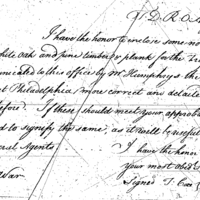
Encloses more detailed notes on size and quantity of white oak and pine timbers for planks for the frigates as requested by Mr. Humphreys. If these notes are approved, he will send copies out to agents.
Ames accepts his appointment as Superintendent of the Public Armory at Springfield. However, when he travelled to Springfield to receive his instructions from Samuel Hodgdon, Hodgdon was not there so Ames is still awaiting his instructions.
The Treasurer has remitted $135 to John Chester for the pay of Capt. Bissell, Lt. Daniel Bissell, and their recruits for the month of July. Ariel Cay cannot be paid as he is confined by civil authority.
The Treasurer will remit to Chester, Supervisor at Weathersfield, $135 for the pay of Capt. Russell Bissell and Lt. Daniel Bissell and the recruits at Middletown for July 1794.
Howell does not approve of the manner in which Lt. Hutchins has taken his receipts and explains that each advance should be receipted separately and the sum expressed in writing.
Samuel Hodgdon will forward to Habersham, Collector at Savannah, one ream of blank muster rolls and one of payrolls to be forwarded to Constant Freeman, Agent for the War Department at Fort Fidius.
Hodgdon will be delivered one ream of blank muster rolls and one ream of blank pay rolls to be forwarded to John Habersham at Savannah, Georgia by the first available vessel.
Hodgdon is directed to deliver to the Governor of Pennsylvania [Thomas Mifflin] two horsemen's tents and six common tents for the accomodation of the troops at Fort Mifflin.
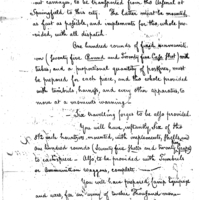
Letter from the Secretary of War to Captain John Barry of the U.S. Navy. Informs Barry that he is to consider himself superintendent of the 44-gun frigate to be built at Philadelphia. Barry's constant attendance will be necessary. Knox then proceeds to describe the current situation in relation to its construction.
Knox asks that Captain Truxton endeavor to find a clerk for the ship yard at Baltimore. Clerk should act in accordance with instructions enclosed. Salary at $750 per year.
Knox discusses plans for the suppression of the Whiskey Rebellion in western Pennsylvania, an insurrection too great to be handled by normal legal means.
The Commissioner of the Revenue requests that Secretary Hamilton place the sum of $4047 in the hands of Nathaniel Gorham of Boston for the purpose of paying for a quantity of copper and tin, necessary for making ten 8-inch Howitz, and for a small advance upon the workmanship, agreeably to a contract with Paul Revere for that purpose.