Secretary Hamilton tells the President that it appears probable that advantages will result from giving to the citizens information on the subject of the disturbances on the western frontier of Pennsylvania -- what later became known as the Whiskey Rebellion.
William Jones of the county of Wilkes makes an oath that four months ago he was employed to go through the Creek country, to carry a letter to Ford, Reid, & Co. at Pensacola, from Willing, Morris, and Swanwick of Philadelphia. After arriving in Pensacola, the Lieutenant Governor directed him to go to the governor at New Orleans. Discusses large quantity of goods for the Creek nation.
Given the fatique, expense, trouble, and risk to which he is exposed, Holt questions whether his salary of something less than thirty-six dollars per month is adequate to the services to be performed.
Holt recommends that his men should be paid monthly as they have become clamorous due to lack of pay. He discusses his apprehensions regarding a possible insurrection of the Negores that prompted him to call out a party of militia to guard the public stores.
Enclosed are copies of Letters to Recruiting Officers dated 1st and 20th of March 1793 and January 23rd 1794. Strict attention should be paid to them to avoid any embarrassments in the settlement of accounts.
After discussing allowances that extend to remittances of money from the War Department, Howell notes that the Secretary of War has set out to the eastward and is expected to be absent for over two months.
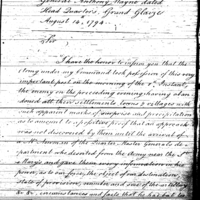
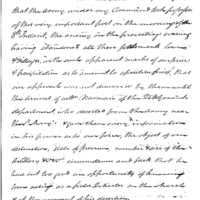
Notification that Wayne's army took control of post at Grand Glaize. Enemy abandoned all settlements the evening prior to U.S. military arrival. Believed enemy had received information on Wayne's movement from a deserter.
Notes that Indians have abandoned Grand Glaize area villages, and that they would have been taken totally unawares if not for the desertion of a quartermaster from the Legion who gave them warning. Expresses astonishment at the amount of buildings and crops. Is erecting 2 forts in the area, Fort Defiance and Fort Adams. Expects campaign to be decided in a confrontation with British and Indians at the British fortification at Roche de Bout. Mentions that he has sent one last peace envoy, but will advance soon nonetheless.
Letter, describes Wayne's campaign; discusses defection of Newman, field quartermaster; discusses Indians and Indian warfare; describes Indian lands; discusses stockade fort; discusses forts and fortifications; mentions militia.
Daniel Houger was paid $27, on the order of Daniel Constable, for publishing an advertisement from the War Department in the South Carolina Gazette and it appears that the account paid was overcharged.
Major General Wayne offered an honorable peace from George Washington to the Chippawas, Delawares, Shawnese, Wyandots, Miamis, Tawas, and Potawatomis. Wayne also requested that the Nations no longer listen to the deception from the men posted at the Rapids.
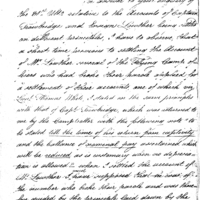
Lt. Leitheiser's account cannot be settled due to a deficiency in his vouchers; receipts have not been produced for the pay of his recruits in December 1793 so they must be sent prior to Hartman's march westward.
Scouts intelligence forwarded to Hamilton because of Secretary of Wars absence. Details on movement of insurgents, and advised on importance of conveying information on their activities.
This is General Wayne's declaration to the Delawares, Shawnees, Miamis, Wyandots, and all other Nations of Indians northwest of the Ohio in which he offers the friendly hand of peace and promises to preserve them and their helpless women and children from the danger of famine.