Informs the Secretary of War that most of the materials for the fortification at Alexandria have arrived, and the batter is being prepared. The palisade and frieze are "much advanced."
Colonel Mentges has noted a deficiency of horsemen's and common tents for the accomodation of the Jersey detachment so the Secretary of the Treasury orders that an immediate supply be sent forward.
The Secretary of the Treasury requests that two brass t welve-pounders. borrowed from the Governor of Pennsylvania, be placed in perect readiness for service.
Letter to the Governor of Pennsylvania, informing him that "disagreeable symptoms" have appeared in the two most western counties of Maryland, related to the Whiskey Rebellion. States that the Jersey militia is being sent to Carlisle.
In the absence of Secretary of War, clerk John Stagg encloses a schedule of several items of money furnished David Henley as agent for War Department in the Southwest Territory.
Secretary Knox encloses a letter form filled out for Captain Talbot. In it are more detailed instructions for his job overseeing the construction of the frigate at New York, which is to mount 44 guns.
Secretary Knox writes a circular letter to each of the agents helping to oversee the frigates under construction providing their specific instructions.
Secretary Hamilton writes the commanding officer of the Maryland militia, Samuel Smith, on assembling the militia to act against the insurgents. The place of rendezvous is Fort Cumberland. Requests that he open a correspondence with Governor Henry Lee of Virginia, in order for the militia of Virginia and Maryland to cooperate
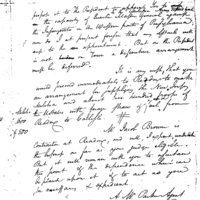
Recommends Miller as Quarter Master General against the insurgents in western Pennsylvania. Miller should proceed immediately to Reading to make arrangements for the supplies of the New Jersey troops. Refers to Jacob Brown, W. Parker, and W. Hodgston as potential contractors in Reading. Asks Miller to appoint appropriate agents. Promises necessary funds.
Informs Governor Lee of Maryland that it is President Washington's desire that no time be lost in uniting the whole of the Maryland militia at Fort Cumberland. If the commanding officer, Samuel Smith, has not already taken the field, it is desirable that he should do it without delay. The militia is being called in response to unrest and rebellion in the countryside, where Americans were revolting against the government, later known as the Whiskey Rebellion
Secretary Hamilton provides a list of necessary materials to the Supervisor of Military Stores. The Virginia and Maryland militias need 6 six-pounders, 3 three-pounders, and 2 howitzers. The Pennsylvania militia needs 6 six-pounders, 4 three-pounders, and 3 howitzers. The Jersey militia needs 3 six-pounders, 3 three-pounders, and one howitzer.
Informs the Secretary of War that the lower work of the fortification at Baltimore is complete. Mentions that "it is almost impossible to get laborers."
Secretary Hamilton writes that Abraham Hunt has informed him that he can procure wagons as far as Reading, Pennsylvania, but not further. Therefore advices Hodgdon to immediately send on a person to engage wagons to take the troops up at Reading. Governor Richard Howell of New Jersey will send the rest of the Jersey militia.
Doctor Waters writes that a "very formidable invasion" by the Creek Nation is nearly certain, and will consist of at least 900 men, aimed at attacking western settlements in the Cumberland region. The doctor allegedly received this information from a Shawanese.