Constant Freeman, agent for the Department of War, reports that Indians in Georgia killed and scalped a white woman and black woman, near the Cow Ford on the Oconee River. They have also stolen horses and negroes from Liberty County. Colonel Gaither has received letters from them that the Tallassee king has gone out for war, with the chiefs disapproving of his conduct.
Among a number of other financial matters, Wolcott assures Hamilton that the means of the Treasury are sufficient to address any emergency that may emerge.
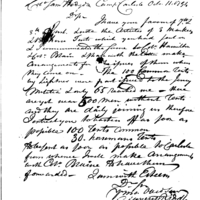
Biddle writes Hodgdon from Camp Carlisle, where more troops are arriving every day but there is a deficiency of tents. Nearly 500 men are without tents, and this number will only get worse. The wagon that brought what should have been 100 tents only brought 65. Biddle asks for another 100 common tents and 30 horsemans tents.
Capt Kelteisen expresses his distress to Howell at not having received orders and having no money to supply the troops. Desertions and a diminished ability to attract recruits have resulted. .
Kalteisen expresses his distress at the failure of the United States to provide even the most essential supplies and he has no money to provide them himself. The quality of the provisions that have been furnished has been poor and all of these problems have hindered his recruiting efforts and resulted in desertions and sickness.
Encloses contract for provisions for 1795 for Fort Washington and Pittsburgh. Requests feedback or orders and information about additional orders of flour and bread. Suggestions about money on treaty.
Letter from the Comptroller of the Treasury to Secretary Hamilton, regarding remittances, compensation, and warrants for sums of money. Discusses the choice of large notes of the Bank of the United States, small notes of other banks, or specie (gold and silver) in order to meet these requirements.
Alexander received $50,000 for pay of militia army called into service by President of United States General George Washington for the suppression of an insurrection in western counties of Pennsylvania.
Stagg informs Alexander that he is responsible for delivering $50,000 to Carlisle for the pay of the militia whose mission is to suppress an insurrection on the frontiers of Pennsylvania.
Stagg notifies Blaime that the Secretary of the Treasury has authorized $50,000 for the use of the militia army and the appropriate receipts should be provided to the bearer, Mr. James Alexander.
Secretary Knox has been informed by the Treasury that Presley Nevill is to be Paymaster of the militia, called into service to quell the Whiskey Rebellion. That being the case, Knox is transmitting a copy of the instructions and forms established by the Comptroller for paymasters of the troops. James Alexander will transmit to Nevill the muster and pay rolls and blank books he will need to fulfill his duties.
Knox informs Blaime of the clothing forwarded to Carlisle for the use of the militia and articles intended for the President of the U.S. forwarded by wagon.
Writes that there are in the store under the care of Captain James Gamble and Richard Parker, sundry Quarter Master's articles as camp kettles, knapsacks, and canteens, which he will take under his direction. Requests that Blaine cause the residue to be forwarded to Bedford immediately.
John Stagg sends true copy of a formal agreement for rations to Major Isaac Craig, Deputy Quartermaster General. The agreement is between Tench Coxe and two contractors. List of rations with amounts.
Verbal communication sent by the Chief of the Wyandols through Enus Khon, a confidential warrior. Rather than long term peace, a truce with the United States was proposed until a council could meet in the spring to discuss terms. It was decided that the British were to guarantee the Indians lands west of the Ohio River if the U.S. did not abandon their forts on the West bank and to fight the Americans. This left the Chiefs of the Indian Nations divided.
Long sought name of person who drew money due him so he may recover money owed him. William Fait previously authorized to draw money, but returned power to Long.
A short sketch of the proceedings of the Council at the Big Rock, by the Wyandot chiefs, on behalf of all their confederates, around October 1794, discussing various issues of the Northwestern Indian tribes.
Captain Howe observes that he is completing the hats and cockaids for his company and notes that his officers need trimming for their hats. To meet this need, he requires lace and hat bands with tassels.