The sum of $698 has been remitted to Edward Carrington, Supervisor at Richmond, being an account of the incidental expenses of the Ordnance department at Norfolk.
The sum of $698 is to be transmitted to Daniel Bedinger, agent for the fortifications at Norfolk., being an account of the incidental expenses of the Ordnance department.
Samuel Fisher will deliver $97.90 for the pay of Lt. Muhlenberg's recruits. When a man makes his mark on the receipt roll, it must be witnessed by a person of respectability.
The Secretary of War wants Hodgdon to send to the War Office the patterns of military clothing for the troops of the United States for the years 1793, 1794, and 1795.
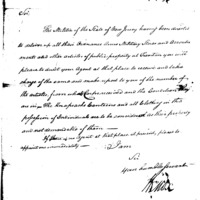
Militia of New Jersey ordered to relinquish all arms, ordinance, and supplies to military stores. Knox advised that the agent should expect to receive and report all objects collected.
Ebenezer Stevens, agent for erecting the fortifications at New York City, requests that Hamilton direct John Lamb (collector of customs for NYC) to make Stevens a further advance on account of the United States for fortifying the harbor of New York. Stevens has vouchers for the whole amount of appropriation made by Congress. Stevens wants to know whether or not the salaries of Chief Engineer Charles Vincent and his assistants are to come out of that appropriation.
Hamilton informs two Baltimore merchants - William Buchanan and Samuel Smith - that a bill from them for $10,000 in favour of Philips & Cramond (Philadelphia merchants) has been presented and will be paid tomorrow.
Lt. Carter's receipt has been received and Dr. Hugh Scott's account may be settled by his providing power of attorney to a friend or by Dr. Scott's making a warrant payable to Carrington.
It is necessary to prove that Capt. Claibourne Lawson was killed in action for his heirs to receive a warrant for the land allowed by the United States.
Mr. Carmaubs [?] has conferred with the Secretary of War concerning improvements in gunnery. Knox wants Hodgdon to furnish him with artificers, a shop, and tools so that he can produce new specimens of gun carriages.
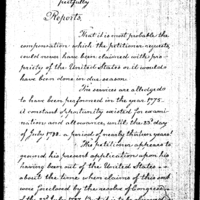
Stearns' petition for compensation is denied. He claims that he was out of the country during the period when such claims were authorized by Congress but in fact he was in Canada only two months and did not sail for Europe until after the period specified by Congress had elapsed.
Capt. Bissell informs Howell that the failure of William Duer has made it necessary to inquire as to how he is to meet his obligations regarding the bills he currently has in his hands.
President Washington replies to the statement by the House of Representatives on the Whiskey Rebellion, delivered by the Speaker Frederick Muhlenberg. Washington is pleased to have the support of the House. States that "every effort ought to be used to discountenance what has contributed to foment it, and thus discourage a repetition of like attempts."
The Speaker of the House, Frederick Muhlenberg, delivered the following address on the Whiskey Rebellion: calls it a "flagrant outrage" and expresses the "deepest regret at so painful an occurrence... as lovers of public order." In a more positive light, Muhlenberg and the House express gratitude in the failure of the rebellion, and the expression of support from most Americans for the United States government throughout the conflict. Finally, the House praises General Anthony Wayne for his "military operations against the hostile Indians," citing his "perseverance" and "prowess."