Jones discusses bills drawn upon Hodgdon by the Quartermaster General relative to advances to wagoners. Hodgdon should separate them according to individual wagoners and specify how much should be advanced to each.
Letter to Thomas Pinckney, U.S. Ambassador to Great Britain. Writes that it has been determined to import from Europe twenty anchors for the use of six frigates. Asks that Pinckney cause the anchors to be procured and shipped. Hamilton advises shipping them to Norfolk, Baltimore, Portsmouth, or Boston.
Secretary Randolph writes that the Director of the United States Mint is of the opinion that it would be advantageous to contract for the 50 tons of copper offered by the Schuyler Copper Mine Company. The price should not exceed that of imported copper.
Among other matters, Ames inquires as to whether a minor who has engaged himself as an apprentice in the public service can be taken away by any person who comes forward as his guardian. The number of apprentices is small anyway but Ames believes that if he authroized to provide suitable encouragement to persons who might allow their sons to be so engaged, the number might be enlarged.
Letter from General Wayne to the Secretary of War, concerning British agents enticing the Indians of the Northwest region to attack the United States. Desires that Congress raise troops to garrison.
Samuel Bayard notes that he has been unable to retrieve Hodgdon's papers due to the interruption of communications between Britain and France. If intercourse between those two countries is restored he will take the necessary measures for getting the papers into his hands. In the meantime nothing is lost since the value of American property will surely rise once the treaty between Britain and the United States is made public.
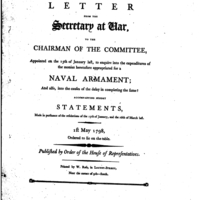
This letter notifies the Secretary at War that public advertisements have been issued for the procurement of naval armaments. The letter also outlines the contractual relationships for the construction of frigates in six port cities.
Lt. McClellan's muster rolls have been received but, since some of the recruits were transferred to Capt. Thompson's command, their pay has been remitted to him.
Lt. Hale's muster roll is being returned so that it can be made to conform with the instructions of the Secretary of War. Tthe muster must be certified on oath as being a true statement of the men under his command.
Hunt announces his arrival with the Jersey Brigade. He is supposed to receive his stores from the Jersey Militia but the tents and arms have been exposed to heavy rain and cannot be received until the tents have been dried out. Perhaps the arms and bayonets should be oiled to prevent damage from the rain.
The Commissioner of the Revenue discusses in detail the preparation for provisions, materials, supplies, and labor in the naval armament, and the construction of frigates.
Report on the construction of the first frigates of the U.S. Navy. Live oak and red cedar will be the materials of choice, though white oak was used for the floor timbers. Captain Barry is certain that live oak may be procured from Georgia, and because of the rapid rate of decay of white oak the cost computed over 40-50 years is the same as live oak. Building a mold loft os too expensive a proposition, so the best one available is rented out at each yard. All the molds are made and marked out with beveling boards, and then the molds are to be shipped to the next naval yard.