
Collection
Transcription Project
-
Compensation of Mr. Warin
The sum of $100 has been remitted to John Chester to be transmitted to Warin through Jedediah Huntington, Collector at New London, for Warin's service as an Assistant Engineer. -
Compensation of Mr. Warin
$100 will be remitted to Chester to be transmitted to Jedediah Huntington at New London who will deliver same to Mr. Warin as compensation for his service as an assistant engineer. -
Charges for Mounting the Cannon at New York
In order to check the extravagant charges for mounting the cannon at New York, Fleming is required by the Secretary of War to provide information that will elucidate the propriety of admitting the amount in question. -
Post Note for $75 Enclosed
Hodgdon encloses a post note for the sum requested by Colonel Olney with the hope that it will safely and speedily arrive in Olney's hands. -
Authorization to Appoint Recruiting Officers
Recruiting officers for the Mera district needed. Advice on performing duties with gentleness. Notification that Knox leaves his post the next day. -
Letter to the President of the United States
Letter from the Secretary of War to President Washington, regarding money and stipulations to the Indians -
Letter from the President of the United States
Personal letter from President Washington to the Secretary of War -
Letter Citation
Cited in Heth to Simmons, 09/06/1795. -
Report on the Militia of the United States
Congressman William Branch Giles (VA) communication to the House of Representatives. Giles headed a committee to prepare a plan for the better organizing, arming, and disciplining the militia. Concludes that the militia suffer from want of a competent source of spplying arms. Resolves that the former act entitled, "An act more effectually to provide for the national defence, by establishing an uniform militia throughout the United States," ought to be amended. -
Letter to the Commissioner of the Revenue
Letter from the Secretary of Treasury to the Commissioner of the Revenue. -
Enclosed letter from naval agent
The Commissioner of the Revenue encloses a copy of a letter from William Pennock, naval agent at Norfolk, Virginia, with an estimate of money wanted to the amount of $7,450 for the freight of timber from Georgia. -
The Articles are Liable for Freight
Hodgdon is admonished that the articles are liable for freight and their company must be notified whether or not they are to be paid. They were assured that they would have no trouble collecting and hope that this continues to be the case. -
Mr. Stille's Account
Mr. Stille's account has been presented for adjustment but, prior to settlement, the time he was employed should be ascertained. Therefore, Hodgdon should provide the appopriate certification of his account. -
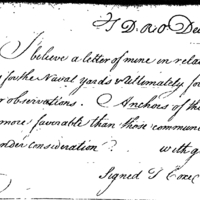
Fire Engines for the Naval Yards
Requests response to previous letter about fire engines in naval yards for ships. Refers to anchors suggested by Mr. Brown and Mr. Francis. -
Alterations in the Account of Capt. John Heth
After restating Capt. Heth's account, there appears to be a balance of $67.43 in his favor after sundry alterations have been made. -
Mounting Artillery on Governors Island
The United States will only pay the expenses for mounting her own cannon so if any of the state business is blended in Stevens' account, it should be deducted and certified by the Commanding Officer of the fortification on Governor's Island. -
Report on the Construction of Frigates
Report by the Secretary of War to the House of Representatives, regarding the frigates authorized by the "Act to provide a naval armament." Knox insists that the vessels be "equal, if not superior, to any frigates belonging tto any of the European powers." The largest ships will be of 44-guns; the others will be 36-gun ships. The frigates will be built of live oak and red cedar. Goes into other various details, including the place of construction. -
Arms and public property lately with militias of Maryland and Virginia are deposited at Winchester, Williamsport or Hagerstown under direction of General Langham
Knox tells Hodgdon that the arms and public property lately with militia of Maryland and Virginia are deposited in either Winchester Virginia, Williamsport Pennsylvania, or Hagers Town Maryland under direction of Major Langham. Asks that Hodgdon direct that arms and accoutrement be cleaned and repaired. Mentions arms deposited at Carlisle, Lancaster, Reading and Trenton. -
Southwest Indian relations
Letter from the Secretary of War to the Governor of Southwest Territory, regarding Indian relations. Reiterates that the destruction of Lower Cherokee towns was not authorized. States that if any Indian commits murder or theft against whites on the frontier, the nation which that Indian belongs to must deliver the offender to the nearest military post to be tried. Likewise, if any white American commits a crime against Indians, or invades their lands, that same white offender shall be subject to the law as well. -
Letter Citation
Cited in Bush to Knox, 01/06/1795. -
Peaceful policy towards the Indians
Secretary Knox submits his observations regarding the preservation of peace with Indian tribes whom the U.S. has formed treaties with. Writes: "The desires of too many frontier white people, to seize, by force or fraud, upon the neighboring Indian lands, has been, and still continues to be, an unceasing cause of jealousy and hatred on the part of the Indians... until the Indians can be quieted upon this point, and rely with confidence upon the protection of their lands by the United States, no well grounded hope of tranquillity can be entertained. The encroachment of white people is incessantly watched, and in unguarded moments, they are murdered by the Indians. Revenge is sought, and the innocent frontier people are too frequently involved as victims in the cruel contest. This appears to be a principal cause of Indian wars. That there are exceptions will not be denied. The passion of a young savage for war and fame, is too mighty to be restrained by the feeble advice of the old men." Knox asserts, "the inability of both parties to keep the peace." Finally, "It seems that our own experience would demonstrate the propriety of endeavoring to preserve a pacific conduct, in preference to a hostile one, with the Indian tribes. The United States can get nothing by an Indian war; but they risk men, money, and reputation. As we are more powerful, and more enlightened than they are, there is a responsibility of national character, that we should treat them with kindness, and even liberality. It is a melancholy reflection, that our modes of population have been more destructive to the Indian natives than the conduct of the conquerors of Mexico and Peru. The evidence of this is the utter extirpation of nearly all the Indians in most populous parts of the Union. A future historian may mark the causes of this destruction of the human race in sable colors." -
Draft of letter to Governor Blount
Secretary Knox submits a draft of a letter to Governor William Blount of Southwest Territory. According to Knox, the situation of the Mero District - facing Indian attacks - demands instant provisions for its protection. -
Certificate of Indian Boundaries from the President
Outlines laws governing boundary between Cumberland and Chickasaw Nation. The various prisoners to be exchanged are discussed, some by name. The Crier of Nickajack is trying to recover his daughter, a prisoner in Kentucky. Discusses conditions for peace, relations between the Cherokee and other tribes, property stolen by Indians. -
Letter Citation
Cited in Coxe to Hamilton, 12/30/1794. -
Letter from the Commissioner of the Revenue
Letter from the Commissioner of the Revenue. Mentions the procuring of timber from Georgia for the naval armament. Also makes mention of Hamilton's coming resignation, along with Knox's resignation, both occurring in the upcoming weeks.