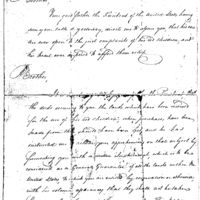
Wants to reassure the chief that the President heard him talk, and that the President's door is always open to the just complaints of his red children. He will give him a written instrument, which he may consider a guarantee of his rights to the land. Offers him money to make him comfortable on the path.
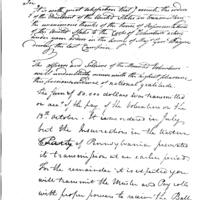
Extends gratitude of President and House of Representatives to Scott's corps of mounted Kentucky volunteers in the late campaign under Anthony Wayne [culminating in the Battle of Fallen Timbers]. Says that certain funds [whether for Scott or for each volunteer is unclear] have now been transmitted, apologizing for the delay caused by the "insurrections in the western parts of Pennsylvania" [the Whiskey Rebellion]. Asks that Scott forward his units' pay and muster rolls, that the balance due to his troops may be paid.
Letter to the Secretary at War, who must soon deliver to the commissioners, plans and memorials relating to the fortifications being built at New York, in defense of that harbor. Mr. Vincent wishes to submit everything for Knox's approval, and is working through Captain Pray to accomplish this.
Secretary Hamilton advices on various measures which he believes the War Department ought to adopt. First, he suggests that the militia be reorganized, and divided into five classes. The first class consisting of all unmarried men between 18 and 25, excepting apprentices and students. The second class consisting of all unmarried men from 25 to 40; the third class all married men from 18 to 25; the fourth class all married men from 25 to 40; the fifth class all men between 40 and 50. Hamilton also advices the creation of a "provisional or auxiliary army," made up of volunteers.
The Commissioner of the Revenue requests that the Treasury take the necessary measures for the reception of the whiskey for 1795 at Fort Washington and Pittsburgh.
Constant Freeman, from Georgia, has been in Charleston with Capt. Joseph Dickens and has mustered Kalteisen's company. Freeman paid Kalteisen for October and November last but would not pay for August and September so Kalteisen is sending Howell the muster rolls for those months, and the current month of December, in the hope that his account can be settled. No returns have been procured from Lieut. Cox relative to his four recruits and one deserter.
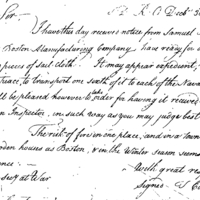
Knox asks that Captain Nicholson and Henry Jackson Naval Agent, concur in the appointment of an inspector. Also asks the the duck [cloth for sails] be stored in a fire proof building.
Knox congratulated Fleming on the work he performed over the past year and felt Fleming was due monetary compensation for his labors. If the repairs to Fort Clinton and Fort Duham were not carried on then the rate of compensation was to decrease.
Secretary of State Edmund Randolph mentions French Minister Jean Antoine Joseph Fauchet, and the latter's request for the right to arm merchant vessels for the purpose of defending them and their cargoes.
The Commissioner of the Revenue discusses Nicholas Hoffman & Co. of New York, which has two or three agencies for the purchase of objects for the military.
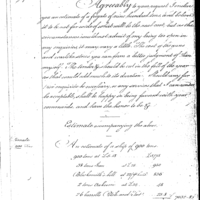
Received notice from Samuel Breck that the Boston Manufacturing Company has sail cloth ready for delivery. Requests information about how to act and inspect. Reminds the risk of fire in Boston.