Letter communicated by Mr. Isaac Williams. Burke notified the Wayandots of Sandusky of a forthcoming visit to discuss the state of their religion and land ownership. Burke advised the Indians to listen to authority sent to protect them.
Speech to Wyandots regarding visit by Burke to discuss religion in village. Recommends moving village closer to Detroit and cabin to be occupied by Burke. Persuasive argument against joining "strangers".
Regarding the claim of petitioner John Clark for pay for services rendered as an auditor, Tracy cannot ascertain whether Clark has been paid in depreciated currency and, if he was, has his depreciation been made up; or perhaps he has received no pay and now wants it. Howell is asked to clarify Clark's case.
Mentioned "vile assassin Wilkinson" believed him to be an agent for the British and Democrats of Kentucky to "dismember the Union." Discussed instance of forged letter.
The Treasurer has remitted sums to Nathaniel Gorham, Supervisor of Massachusetts, being for the pay and subsistence of Lieutenant Hale and the pay of his recruits. Receipts must be collected and if a recruit makes his mark it should be witnessed by a person of respectability.
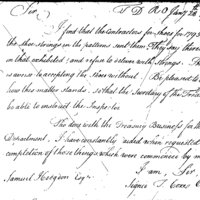
Reports that shoe contractors object to the shoe strings in the plans. Requests information so that the Secretary of the Treasury can make a decision. Has completed treasury business with the War Department.
The Treasurer will remit to Gale a sum to be transmitted to Captain James Bruff, being for the pay of his recruits for the last quarter of 1794 and for which receipts will be required.
The Treasurer has been directed to remit to George Gale, Supervisor at Baltimore, a sum to be transmitted to Bruff for the pay of the non-commissioned officers and privates in his Company. Receipts must be collected and if a signature is not written, the mark must be witnessed by a commissioned officer or a person of respectability.
Certification that $270.20 is due Lieutenant Thomas Underwood of the Corps of Artillerists and Engineers, being for his pay and subsistence for June through December 1797.
Howell transmits the charge against Silas Linsman, deputy agent with the Cherokee Indians, asking Harrison to inform him as soon as the amount is accounted for so that Linsman's account can be balanced in Howell's books.
Howell inquires as to whether the payment of rations, provided under the contract of William Duer and claimed by officers of the Army, should be made. Howell wants to know whether these claims should be discharged given the fact that Duer's contract was settled for a specific period with only one ration allowed for each officer during that period.