President received letter from T.Carnes and J.Gunn, regarding Indian rights to land inside current U.S. boundary. Discussed current unrest among Creeks and urged delicacy in pursuing this issue. State of Georgia passed legislation to investigate claims. Copy of resolution to investigate enclosed.
Vincent transmits the state of the sum owed for the compensation of the engineer employed by the United States. He laments that he and his men are truly poor, have no credit, and cannot subsist without ready money. He pleads with Hodgdon to give serious consideration to their claims for compensation.
Act to Provide for Calling Forth the Militia to Execute the Laws of the Union, Suppress Insurrections, and Repel Invasions; and to Repeal the Act Now in Force for those Purposes. Although John Church Hamilton attributes this document to Hamilton [JCH Transcripts; JCHW, V, 103], Harold Syrett, editor of the Papers of Alexander Hamilton, found no evidence to support that contention [Syrett, PAA, XVIII, 286]. Cited in Syrett, PAA, XVIII, 286.
Orders to hand enclosed letter and papers to President. Enclosures are results from Conference at Greenville which will be followed by Treaty of Greenville around the 15th of next June in1796. Remaining hostile tribes would like to pursue peace.
Apparently Mr. Woodruff did not give Dayton a copy of the questions and entire answers regarding the pay of the Jersey Militia. Pickering leaves it to Dayton's discretion to determine what compensation should be allowed the paymasters or other agents who should actually pay the militia.
Major Craig points an error on the quartermaster statement received from Samuel Hodgdon. Craig proceeds to make explanation for this error in accounting.
Dayton sends Hodgdon a bill of exchange and duplicate for $1500 from a Mr. Ludlow. Dayton requests an advance of half this sum, and comments that he will enter into a contract if necessary that allows for interest or damages to be paid if Hodgdon deems this necessary. Dayton remarks that he does not feel this would likely happen as Ludlow has informed Dayton that the money is in his possession and Dayton may simply draw from it.
Major Craig points out to Pickering the tremendous expenses involved in procuring, preserving, and distributing beef and pork among the outposts. Pasturage and slaughering expenses are incurred in providing fresh meat. Preserved meat entails expenses due to repackaging and salting. Additionally, Craig informs Pickering that, because an Indian has been killed at Fort Franklin, funds have been disbursed to Colonel Butler for the compensation of the bereaved.
Colonel Fish, the Supervisor of New York, has been furnished with three hundred dollars to be transmitted to Captain Thompson for the use of the recruiting service.
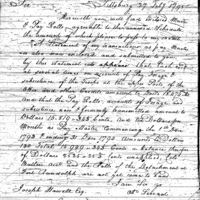
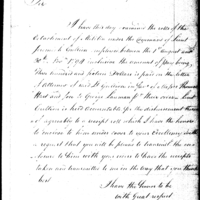
Howell has settled the rolls for the detachment under Guillion's command for the period from August through November 1794 in the amount of $316. This sum has been paid on Guillion's Power of Attorney to Thomas Hart & Sons per their order to George Lauman. Guillion is responsible for the disbursement according to the enclosed receipt roll.
After examining the rolls of the detachment of militia under the command of Lieutenant Jeremiah Guillion, Howell concludes that Lieutenant Guillion is held accountable for the disbursal of pay agreeable to the enclosed receipt rolls.
Pickering notes that the clothing may be sent to New York from which place vessels frequently sail to Wilmington. The arms may be sent down the river to Reedy Island where they will be loaded on a vessel sailing to Europe.
Letter, encloses receipts of John Habersham, Collector of Savannah, for monies applied by him towards defraying the incidental and contingent expenses of the Department of War in Georgia.
Voorhes to deliver cannon. Missing muskets, bayonets, and pistols need to be found. Hunt proposed placing an advertisement in newspaper for arms but requests advice on subject.