Pickering expresses his disappointment that Mr. Francis declined receiving the ash [?] which could have been used in the fortifications as well as on ship board for working the great guns. He is apprehensive about receiving them in the public stores where they will take up more room than they are worth.
Refers to a problem with storing handspikes -- if they cannot be stored at the shipyard, Pickering notes that placement in the common storage would cost more than the entire cost of the handspikes. Appended is a list of some measurements or values for the forward [before] and aft [abaft] sections of a ship.
The interim Secretary of War faults the Chickasaws for the last conflict between the Chickasaw and Creeks. The U.S. will not support the Chickasaw. Transportation of supplies to be given to Chickasaws relayed. Also mentions the storing and issuing Indian supplies at Knoxville
Bryant sends Hodgdon the return for ordnance and stores for April. 23 carriage bodies for six-pound guns have been furnished, including four pairs of limbers. More wheels are still being fabricated, and Bryant promises to have the job finished as quickly as possible.
Wadsworth has received Simmons' letters and will follow the instructions enumerated within. He also received the money remitted to the supervisor of his account and will send him duplicate receipts.
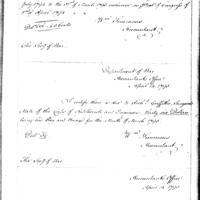
Simmons certifies that the sum of nineteen dollars is due Nicholas de Finiels, temporary assistant Engineer, for the balance of his account of pay and expenses for April 1795.
Timothy Pickering, interim Secretary of War, reports that Mr. A. Foster can furnish supplies to the Chickasaw and Choctaw tribes at a cheaper rate for the government. President Washington promised to provide supplies to Chickasaw chiefs when they visited Philadelphia, worth $3000 in goods. If Hamilton approves of giving Foster the exclusive right to furnish the supplies, the purchasing agent (Mr. Percey) must be instructed accordingly, as well as Col. David Henley.
William Simmons notifies John Polhemus that Major Craig has been directed to collect the unpaid balances on his accounts. Simmons instructs Pohemus on proper record keeping.
William Simmons notifies Captain John Crawford that Major Isaac Craig will henceforth be responsible for the financial administration of Fort Fayette. Captain Crawford is to settle pay matters through Major Craig.