There is some question regarding the authenticity of several names appearing on the payrolls. Sproat says he did not see all of the men sign but the names have been certified by the appropriate magistrates so they should be legimate.
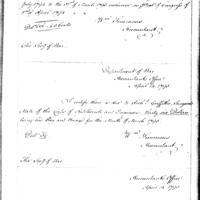
Simmons certifies that $59.82 is due James Hackett, Constructor of the Frigate building at Portsmouth New Hampshire, being the balance of his salary from August 15th 1794 through June 1795.
Simmons certifies that $42.46 is due Jacob Woolwine, a Sergeant in Captain Alexander Gibson's Company 1st Sub Legion, being his pay from June 1st to July 2nd 1795, being the expiration of his service.
Simmons certifies that $343.50 is due Major John Jacob Ulrich Rivardi for the balance of his account for compensation from March 28th 1794 to April 7th 1795, and for personal and extra expenses as temporary engineer.
Prisoner exchange, description rules governing the council/gathering. Issues of provisions, peace, alliance, land rights, and compensation for land purchase. Shawnee and Wyandots of Detroit remain allies with the British. Indian tribes relinquish land to U.S. and bury their war belts.
Peace treaty between the United States and the Northwest Indian Confederacy, comprised of the Wyandots, Delawares, Shawnees, Kickapoos, Weas, Ottawas, Chippewas, Putawatomie, Miami, & Eel River tribes. Dictates the end of hostilities, the return of prisoners, cessions of land to the U.S., the new Indian-U.S. boundary, right of white passage over Indian land and waterways, the relinquishment of all other U.S. claims to these Indians' land in the Great Lakes region, U.S. annuities to each Indian tribe, the forfeiture of U.S. protection for any future white settler on Indian lands, trade regulations, the voiding of all other treaties made since the peace between America & Great Britain in 1783, and overall friendship for the future. Signed by all the tribes mentioned in the address, along with the Kaskaskias and the Piankeshaws (being signed for by the Weas). Also signed by U.S. army officers and sworn interpreters.
Peace treaty b/w U.S. and hostile tribes of North West of Ohio river signed and copy enclosed. Addressed concerns about soldiers receiving clothing due them after their discharge. Believed that poor book keeping lead to improper dispensation of clothing. Discussed treaty with Great Britain and the sentiments of the dissenters. Lack of supplies at post rampant due to late shipments.